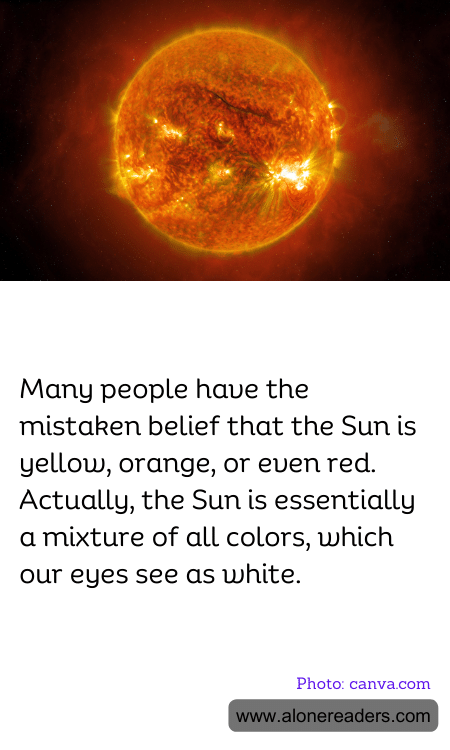
The Sun, our closest star, often appears yellow, orange, or even red when viewed from Earth. This common perception, however, doesn't fully capture the Sun's true color. In reality, the Sun is essentially white, a fact that becomes highly evident when viewed from space.
The misunderstanding regarding the Sun's color primarily arises due to the way Earth's atmosphere interacts with sunlight. Sunlight is composed of all colors of the visible spectrum, which combine to produce white light. However, as sunlight passes through our atmosphere, shorter wavelengths (blue and violet light) are scattered in all directions by the air molecules, a process known as Rayleigh scattering. This scattering causes the sky to appear blue, but it also influences how we perceive the color of the Sun.
During sunrise and sunset, the Sun’s light has to travel through a larger portion of the Earth's atmosphere compared to when it is high in the sky. More atmospheric scattering occurs, which removes a significant amount of shorter wavelength light and allows more of the longer wavelength red and yellow light to reach our eyes, making the Sun appear reddish or orange. This effect is intensified when there are particular atmospheric conditions, such as the presence of dust or pollution.
From the vantage point of space, without Earth's atmosphere filtering and scattering the sunlight, the Sun appears as a true white, signifying the equal mixture of all colors which it inherently emits. This white color accurately reflects the Sun’s surface temperature of about 5,500 degrees Celsius. Colors associated with lower temperatures, such as red or orange, do not represent the Sun’s surface effectively.
In scientific contexts, especially in astrophysics and meteorology, understanding the Sun’s true white color is essential for studying its spectral classification, energy output, and the influences it has on Earth’s climate system. For casual observers on Earth, though, the view of a yellow or even sometimes red Sun continues to provide a visually dramatic element to our natural world, enhancing sunrises and sunsets with its vivid hues.
