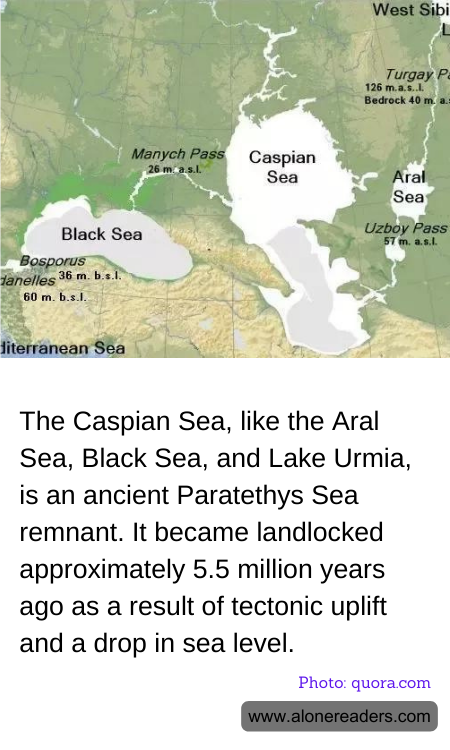
The Caspian Sea, the world's largest inland body of water, straddling the border between Europe and Asia, holds the storied past of being a relic from the ancient Paratethys Sea. This prehistoric sea was significantly larger than today's Caspian Sea, spreading across much of Eastern Europe and Western Asia before geological changes transformed the landscape. About 5.5 million years ago, during the Messinian age of the Miocene epoch, profound shifts such as tectonic uplift and fluctuations in sea levels caused the vast Paratethys to become segmented and diminished, eventually evolving into several smaller basins of which the Caspian is the largest.
Similarly, the Black Sea and Lake Urmia share this legacy. The Black Sea was connected to the Caspian via the Manych Spillway, forming part of the extensive marine system before becoming landlocked through similar processes involving tectonic activity and reduced sea levels. Lake Urmia, on the other hand, although smaller, illustrates the same historical pattern of separation and decline, underscoring the dynamic nature of Earth's geological processes.
These transformations not only shaped the physical geography of these regions but also had far-reaching implications for their climatic conditions, ecosystems, and the human settlements over millennia. The Caspian Sea, now bordered by five countries—Russia, Kazakhstan, Turkmenistan, Iran, and Azerbaijan—plays an essential role in regional economies, primarily through oil and gas reserves and fisheries. Moreover, the ecological uniqueness of the Caspian has also meant that it provides habitats for many unique species, although environmental changes and human activities continue to pose risks.
The Aral Sea's fate has been most tragic, experiencing one of the world's worst ecological disasters due to Soviet-era water diversion projects for agriculture, which dramatically shrunk its size and devastated its ecosystem. This highlights the profound impacts of human intervention on natural bodies, contrasting sharply with the primarily natural evolutionary processes seen in its neighboring seas.
These bodies of water provide critical historical data for scientific research, hosting clues about climate change, evolutionary biology, and geological activity over millions of years. They remind us of nature’s ability to change and adapt, presenting both a history lesson and a cautionary tale about the importance of sustainable environmental management.
