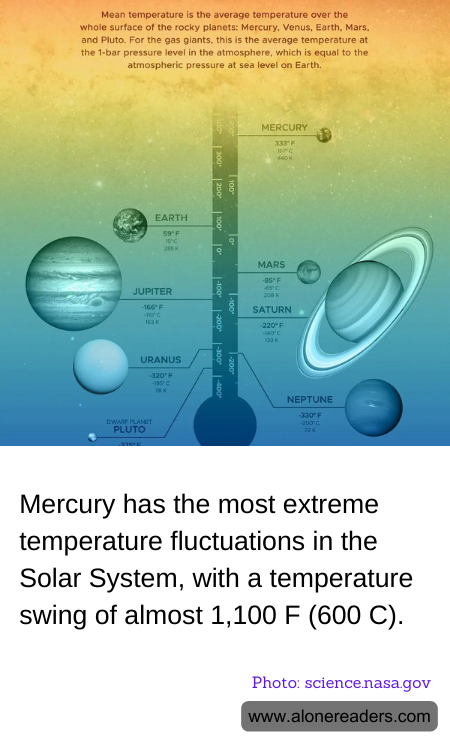
Mercury, the closest planet to the Sun in our Solar System, experiences the most extreme temperature fluctuations of any planet. Its proximity to the Sun and its slow rotation contribute significantly to these wild temperature swings, ranging from scorching highs to icy lows. The temperature on Mercury's surface can soar to 800 degrees Fahrenheit (430 degrees Celsius) during the day—hot enough to melt lead. Conversely, without a substantial atmosphere to retain the heat, nighttime temperatures on the planet can plummet to -290 degrees Fahrenheit (-180 degrees Celsius), resulting in a staggering temperature variation of nearly 1,100 degrees Fahrenheit (600 degrees Celsius).
This vast range in temperatures is largely due to Mercury’s thin atmosphere, which is composed mostly of oxygen, sodium, hydrogen, helium, and potassium. This sparse atmosphere offers no substantial protection from the Sun's heat and is unable to trap heat during the night. Moreover, Mercury's slow rotation means that it completes only three rotations on its axis for every two orbits around the Sun, which equates to one Mercury day lasting about 176 Earth days. This slow rotation permits the sunlit side of the planet to bake under the solar heat for an extended period, while the night side remains enveloped in darkness, rapidly cooling down due to the absence of an atmosphere to keep the warmth in.
These conditions make Mercury a planet of extremes—not only in terms of its temperature but also its environment. The intense temperature variation has dramatic implications for the surface of the planet, leading to the formation of long, steep cliffs, some of which rise up to a mile high and stretch for hundreds of miles. These geological features, or scarps, are believed to have formed as the planet's interior cooled and contracted over millions of years.
Understanding Mercury’s extreme temperature fluctuations is crucial for scientists studying the planet's geology and its potential for supporting life. While current conditions make the existence of life as we know it improbable, insights into Mercury's adaptation to such extremes can provide valuable knowledge about planetary science applicable to other celestial bodies, including exoplanets in different solar systems.
