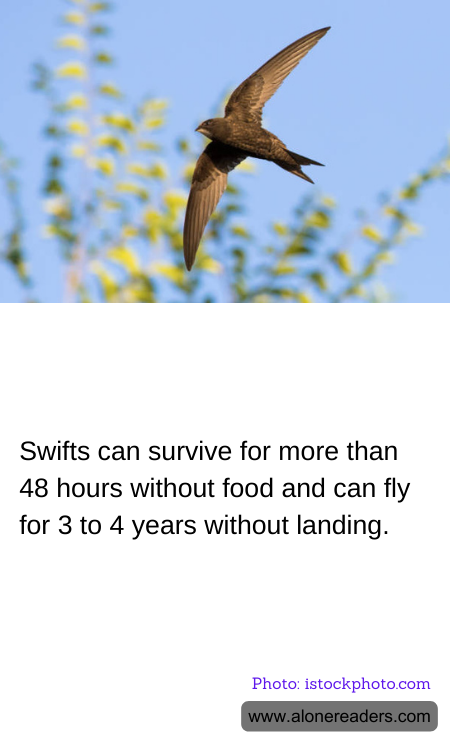
Swifts, among the most aerial of birds, display some of the most fascinating flight endurance abilities in the animal kingdom. These birds, particularly known for their slender bodies and crescent wings, spend most of their lives in the air, showcasing feats that seem almost unimaginable. Researchers have found that some species of swifts can indeed survive for more than 48 hours without food. This is a crucial ability, as their life on the wing does not readily accommodate frequent feeding.
Moreover, swifts' capacity for sustained flight truly sets them apart. Studies conducted particularly on the Common Swift (Apus apus) have revealed that these birds can fly for incredibly long periods without landing — up to three or four years continuously. During these years, swifts perform virtually all of their essential life processes in flight, including sleeping, mating, and gathering food. They can even sleep while flying by shutting down parts of their brain alternately. This ability is supported by their highly efficient flight mechanics and a physiology adapted to long-term energy management.
This extraordinary endurance comes from evolutionary adaptations that are key to their survival. For instance, their metabolic rate adjusts to various conditions, and their muscular and skeletal structures are optimized for near-constant flight. The wing shape of swifts, which is long and narrow, resembling a scythe, also aids in their ability to stay aloft by providing superb aerodynamics for gliding with minimal energy expenditure.
The capacity to fly for years without landing also has broader implications for how swifts interact with their ecosystems. It influences their feeding habits, breeding cycles, and migration patterns, allowing them to exploit air-borne insects across vast geographical ranges and thereby avoiding terrestrial predators. This lifestyle, however, poses certain risks, including high energy demands and exposure to adverse weather conditions which they have to navigate continuously.
Studying the way swifts manage such extremes of endurance flight not only expands our understanding of avian biology but also enriches our insight into the limits of vertebrate physiology and adaptability. Their remarkable life in the sky offers intriguing perspectives on survival strategies in nature, showcasing a stunning example of what evolution can accomplish in terms of optimizing life to fit into ecological niches. ??
