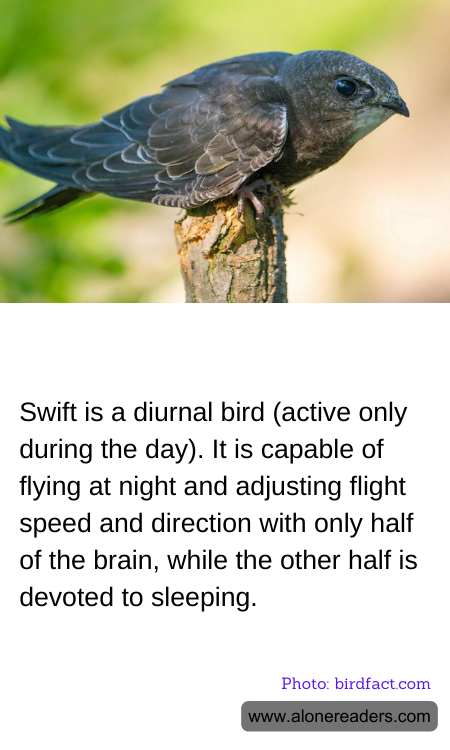
Swifts are among the most intriguing and enigmatic birds, renowned for their impressive aerial abilities and unique physiological adaptations. Contrary to common belief, they are not exclusively diurnal, or active during the day. Swifts are capable of sustaining flight for extended periods, including at night, which is crucial for their long migratory journeys and constant search for food.
One of the most remarkable aspects of swifts’ behavior is their ability to manage sleep while in flight. Researchers have discovered that these birds can fly for days, weeks, or even months on end without ever landing. To cope with the demands of such prolonged activity, swifts have evolved a fascinating method of resting half of their brain at a time, a phenomenon known as unihemispheric slow-wave sleep. During this process, one hemisphere of the brain remains awake and fully functional, allowing the bird to continue controlling its flight with precision, while the other half rests. This adaptation ensures that the swifts are able to maintain basic bodily functions, like navigating and avoiding predators, while also getting the essential rest needed.
The ability to adjust flight speed and direction while half the brain sleeps is an extraordinary feature that highlights the swift's adaptation to its aerial lifestyle. Their bodies are designed for minimal energy consumption during flight, with long, narrow wings and a lightweight frame that allows for swift and efficient movement through the air. This enables them to traverse vast distances, particularly during their migratory seasons, when they travel from Europe to Africa and back.
Moreover, swifts’ sleep habits during flight are not just a marvel of nature but also a subject of significant scientific interest. Studying these patterns provides insights into sleep mechanisms and the potential for understanding sleep in other species, including humans. It opens up possibilities for learning how sleep could potentially be managed in extreme conditions, contributing to research fields like medicine and even space travel, where sleep management is a critical challenge.
In conclusion, swifts are not just day-active birds but are equipped with exceptional capabilities that allow them to navigate and survive in their environment. Their ability to fly at night and manage sleep unilaterally is a testament to the incredible adaptations that evolution can produce, making them a fascinating subject of both admiration and scientific study.
