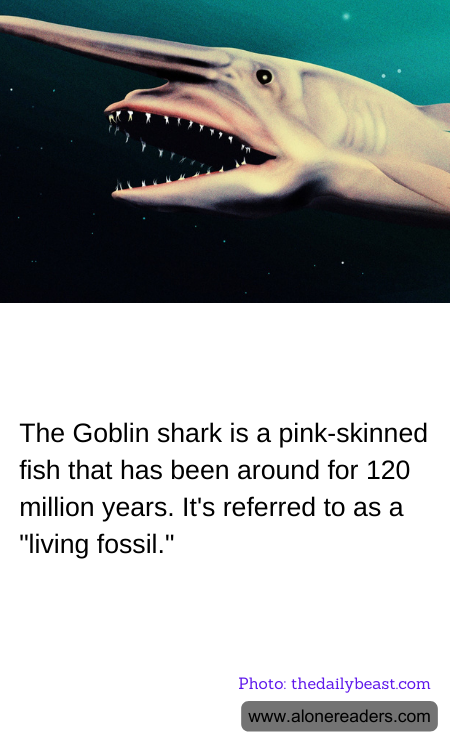
The Goblin shark, scientifically known as Mitsukurina owstoni, stands out as a unique species in the oceanic world due to its distinct appearance and ancient lineage. Characterized by its bluish-pink skin, elongated snout, and prominent jaw structure, this shark is often referred to as a "living fossil" because it represents a prehistoric lineage that has persisted relatively unchanged for about 120 million years.
Goblin sharks inhabit deep waters, generally found at depths from 100 to 1,200 meters below the surface. They are most commonly located off the coasts of Japan, but they have also been spotted in other areas of the Pacific Ocean, including Australia, and even as far as the Atlantic Ocean and the Gulf of Mexico. Due to their deep-sea habitat, Goblin sharks are rarely seen by humans, which adds an element of mystery and intrigue to their existence.
What sets the Goblin shark apart from other shark species is its remarkable method of catching prey. Its jaw is highly specialized; capable of rapid projection, the shark uses a slingshot-like mechanism to thrust its mouth forward and nab prey. This feature is particularly useful in the deep-sea environment where food sources may be scarce and difficult to catch. The shark’s diet mainly consists of deep-sea fish, cephalopods, and crustaceans.
The pinkish coloration of its skin, which aids in camouflage at great depths, is another fascinating aspect of the Goblin shark. This color is due to the visibility of oxygenated blood through its semi-transparent skin, which can help it blend with the limited light in its deep underwater habitat.
Despite their ancient origins and interesting morphology, Goblin sharks are seldom studied due to their elusive nature. However, they are considered of least concern by the International Union for Conservation of Nature (IUCN), mainly because there has been no significant demand for their capture, and they are infrequently caught by deep-sea fisheries. Nonetheless, like many deep-sea creatures, the Goblin shark could be vulnerable to environmental changes and human activities such as deep-sea fishing and ocean-floor mining that may disrupt their habitat.
As a species that is both biologically fascinating and poorly understood, the Goblin shark presents a valuable opportunity for scientific study. Each sighting and subsequent examination provides critical insights into the life of these enigmatic creatures and helps to piece together the evolutionary history and ecological dynamics of deep-sea environments.
