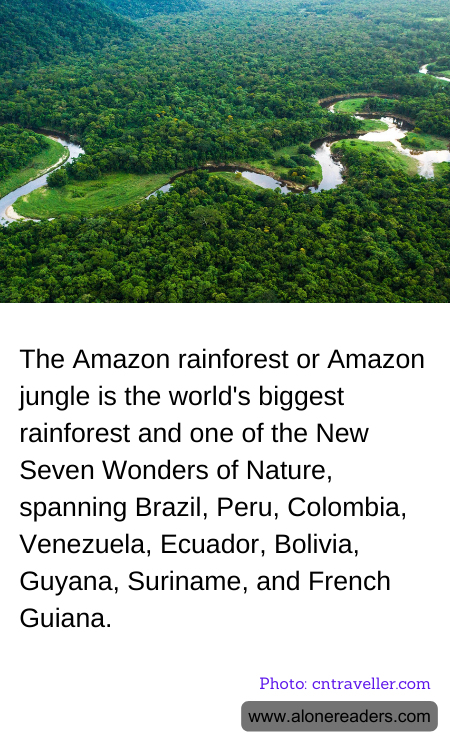
Spanning over 5.5 million square kilometers across nine South American countries, the Amazon Rainforest is a colossal expanse of biodiversity and natural beauty. It is not only the largest rainforest in the world but also plays a crucial role in the global climate system and the Earth's ecological balance. Often referred to as the "Lungs of the Earth," the Amazon is responsible for producing about 20% of the world's oxygen, an essential element of life. Its vast green canopy, comprising millions of trees, absorbs large quantities of carbon dioxide, helping mitigate global warming.
The Amazon Rainforest is home to an astonishing variety of wildlife, with estimates suggesting that one in ten known species on Earth lives here. This includes over 2,000 species of birds, 430 species of mammals, and a mind-boggling 40,000 plant species. Some of the wildlife is unique to the Amazon, emphasizing its irreplaceable role in global biodiversity. Among its rich fauna are iconic species such as the jaguar, the Amazon pink river dolphin, the sloth, and countless other species, many of which are unidentified or endangered.
However, the Amazon Rainforest is under significant threat due to deforestation, illegal logging, mining, and agricultural expansion, particularly cattle ranching and soy cultivation. These activities not only threaten the diverse ecosystems within the Amazon but also the indigenous tribes whose livelihoods and cultures are intimately tied to this region. These communities are among the most vulnerable, often lacking the political support needed to protect their lands and heritage.
The preservation of the Amazon Rainforest is thus not just an environmental imperative but a social, economic, and political challenge as well. International cooperation and sustainable management strategies are crucial in safeguarding its biodiversity and the global environment. Efforts to combat deforestation, promote reforestation, and support sustainable livelihoods for local communities are vital. Moreover, understanding the intrinsic value of the Amazon beyond economic terms is essential for its survival and the health of our planet.
In summary, the Amazon Rainforest is a natural wonder integral to our world's ecological and cultural fabric. Protecting it requires immediate and sustained action, drawing on both scientific expertise and traditional knowledge. Its future is pivotal not just for the species that inhabit it or the communities that depend on it, but for the entire globe, given its profound impact on climate regulation and biodiversity.
