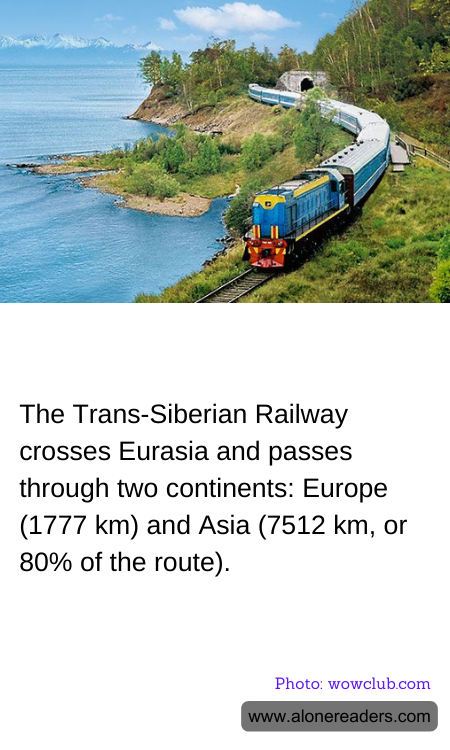
Spanning an impressive 9,289 kilometers, the Trans-Siberian Railway stands as a monumental testament to engineering and human endeavor, seamlessly stitching together the vast expanses of Eurasia. Initiated during the reign of Tsar Alexander III in 1891 and completed under his son Tsar Nicholas II in 1916, this rail route is not just a lifeline for transport but also a cultural and historical phenomenon. It stretches from Moscow in the west to Vladivostok in the east, heralding its presence across two continents: Europe and Asia.
The journey begins in Europe, where 1,777 kilometers of track remind travelers of the dense, historical tapestry of the Western world. This portion of the journey highlights the deep connection and accessibility between European Russia and its Asiatic parts, providing not only a practical route for freight and travelers but also symbolic of the blending cultures at the geographical crossroads.
As the train chugs eastward, crossing the boundary into Asia, the landscape undergoes a dramatic transformation. Over 80% of the railway, approximately 7,512 kilometers, passes through Asia, offering a vivid tableau of the continent's diverse geography and culture. From the dense forests of Siberia, the steppes of Mongolia, to the shores of Lake Baikal—the world's deepest freshwater lake—the railway acts as a silent observer to some of the most remote and undisturbed parts of the planet.
For many travelers, the journey is as much about the landscapes and cities that dot along the route as it is about introspection and discovery. Each station along the way offers a unique peek into the local life, allowing passengers to witness the melting pot of cultures, traditions, and histories that is intrinsic to the region. Meanwhile, the railway itself serves as a lifeline for the remote communities it passes, providing essential connectivity and support to far-flung towns and cities.
The Trans-Siberian Railway not only facilitates economic activity through the transport of goods and people but also promotes tourism across Eurasia. It attracts thousands of adventurers, curious to embark on one of the longest train journeys in the world, eager to see the unseen and explore the breadth of the two continents from the comfort of a train compartment.
In conclusion, the Trans-Sarian Railway does more than just span the massive landscape of Eurasia. It connects the past with the present, the East with the West, and humans with the natural world in a profound dialogue that has lasted over a century. It remains a vital artery of commerce and culture and an emblem of the adventurous spirit that defines humanity’s relentless quest for exploration and understanding.
