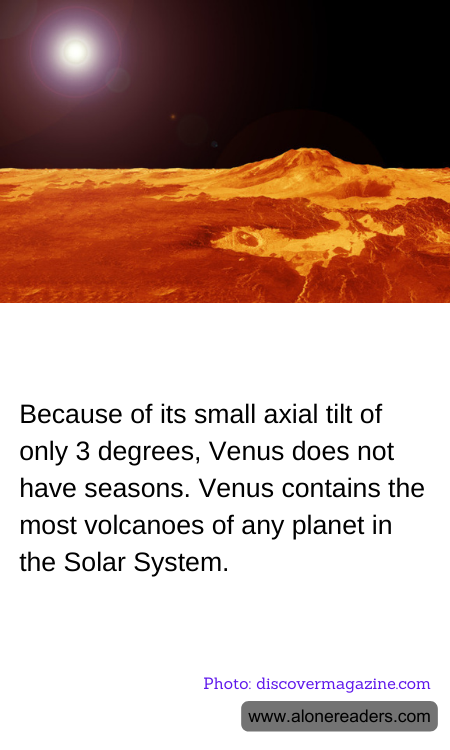
Venus, often termed Earth's "sister planet" due to its similar size and proximity, exhibits several fascinating and extreme characteristics that set it apart from other planets in the Solar System. One such feature is its minimal axial tilt of only about 3 degrees, unlike Earth which tilts at approximately 23.5 degrees. This slight tilt on Venus is responsible for its lack of noticeable seasons. On Earth, the significant tilt results in the planet experiencing varying solar energy distributions throughout the year, leading to distinct seasonal changes. However, Venus’s almost upright spin axis means that sunlight is distributed more or less evenly across the planet throughout its orbit, resulting in a relatively stable and uniform environment all year round.
Adding to its mystique and hostile nature, Venus hosts the most volcanoes of any planet in the Solar System. While the exact number is not known, scientists estimate that there are more than 1,600 major volcanoes on Venus, but the total count, including smaller volcanic formations, likely extends into the tens of thousands. Unlike Earth, where plate tectonics play a significant role in volcanic activity, Venus' surface is thought to be composed of a single lithospheric plate that covers the entire planet. This results in a volcanic style referred to as a "pancake" eruption due to the shape of the lava flows that spread in wide, flat sheets.
Interestingly, most of Venus’s volcanoes are believed to be shield volcanoes, which are built almost entirely of fluid lava flows. This type of volcano forms gradually over time with lava pouring out of vents and flowing in all directions, creating broad and gently sloped structures. In contrast to Earth, where active volcanoes are closely monitored to predict and mitigate their potentially devastating effects, the volcanoes on Venus may not be active today. Current research based on observations from spacecraft such as Magellan, which orbited Venus from 1990 to 1994, suggests that while volcanic activity has certainly shaped much of Venus’s surface, these processes have largely slowed or ceased in the recent geological past.
The combination of its uniform climate due to the lack of axial tilt, and its dense, volcano-sculpted surface, makes Venus a compelling study subject for understanding planetary processes in extreme conditions. Scientists continue to decode the mysteries of this enigmatic planet through advanced space missions and telescope observations, uncovering the secrets held by our closest planetary neighbor.
