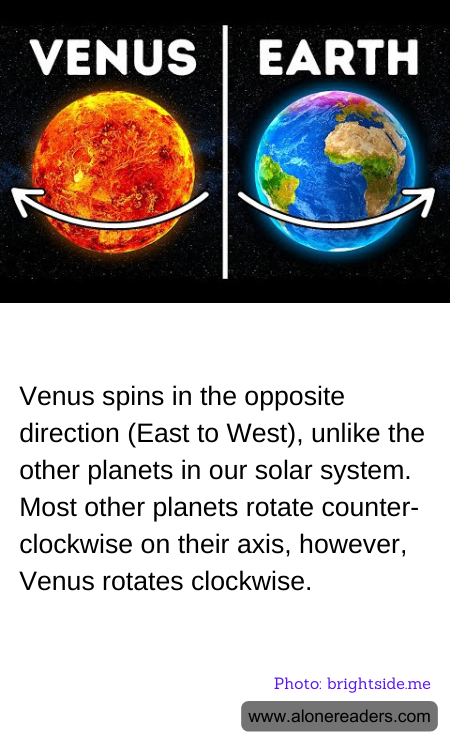
Venus, often referred to as Earth’s “sister planet” due to its similar size and proximity, exhibits a unique peculiarity in its rotation. It spins in the opposite direction to most other planets in the solar system. While planets like Earth rotate from west to east (counter-clockwise if viewed from above their north poles), Venus spins from east to west, or clockwise. This unusual trait is known as retrograde rotation.
The reasons behind Venus’ peculiar spin direction are still subjects of research and debate among scientists. One of the prevailing theories suggests that this retrograde rotation could be the result of a colossal collision with a large celestial body early in Venus' history. Such an impact would have been powerful enough to alter the planet’s original rotation, flipping its axis or reversing its direction. Another hypothesis proposes that gravitational interactions with the sun and other planets over billions of years could have influenced the rotational dynamics of Venus, gradually leading to its current state.
Despite rotating backward, Venus also has an extremely slow rotation rate. It takes about 243 Earth days to complete one full rotation on its axis, making a single day on Venus longer than a Venusian year, which is about 225 Earth days. This slow rotation contributes to extreme conditions on the planet's surface, such as prolonged periods of daylight and darkness, which subsequently affect its atmospheric conditions.
Moreover, Venus’ atmosphere, composed predominantly of carbon dioxide with clouds of sulfuric acid, spins much faster than the planet itself, a phenomenon known as super-rotation. The upper layers of the atmosphere can complete a full rotation in just about four Earth days, compared to the planet's surface. This fast-moving atmosphere could be redistributing heat around the planet, playing a vital role in the extreme greenhouse effect that makes Venus the hottest planet in our solar system despite being second from the sun.
Understanding Venus and its unique rotational characteristics not only uncovers more about our own planet’s history and the dynamics of our solar system but also contributes to our knowledge of planetary formation and evolution in the universe at large.
