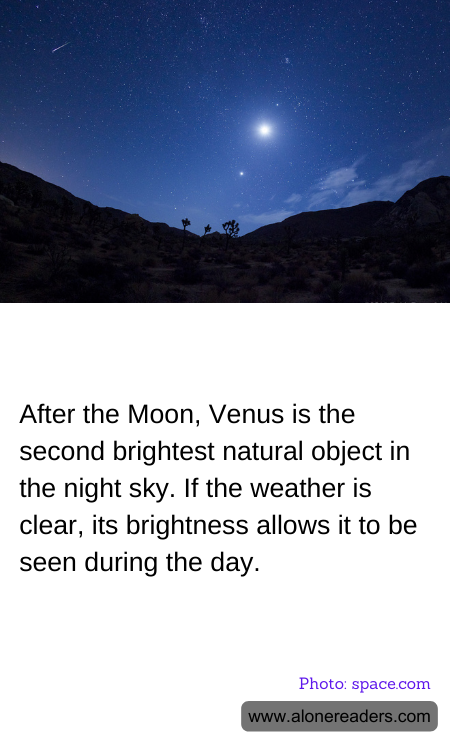
Venus, often called Earth's "sister planet" due to similarities in size, composition, and proximity, holds a unique distinction in our night sky. It shines as the second brightest natural object after the Moon, a luminous presence that has captured human interest for millennia. This brightness is primarily due to its dense atmosphere composed largely of carbon dioxide, with clouds of sulfuric acid, which efficiently reflects the sunlight that reaches it.
The visibility of Venus is not just confined to the night. Remarkably, under clear weather conditions, Venus can also be seen with the naked eye during the day. This ability to cut through even the bright light of the sun to make itself visible speaks to its incredible albedo, or reflective power. Its position in the solar system also contributes to this visibility; Venus orbits closer to the Sun than Earth, positioning it often in our sky either right after sunset or just before sunrise. This is why Venus is also commonly known as the Morning Star or the Evening Star, depending on when it is visible during its orbit.
Venus's presence in the sky is not constant but goes through phases similar to the Moon, from fully illuminated to just a slender crescent. These phases depend on the relative positions of the Sun, Venus, and Earth, and contribute to the variations in its brightness as seen from Earth. When Venus is between Earth and the Sun, it shows its crescent phase to us, and when it is on the opposite side of the Sun relative to Earth, it appears fully illuminated.
Observing Venus can serve as a captivating astronomical activity, even with simple binoculars or a small telescope, revealing its phased nature much like that of our Moon. Observations over time show not only its phases but also illustrate the planet’s movement relative to the stars and other planets.
The brilliance and unique orbital characteristics of Venus have assured it a prominent place not only in the realm of scientific study but also in culture and mythology across civilizations. Its consistent brightness and ability to be seen during the daytime make it an exceptional feature of our sky, serving as a reminder of the dynamic and ever-changing nature of our solar system.
