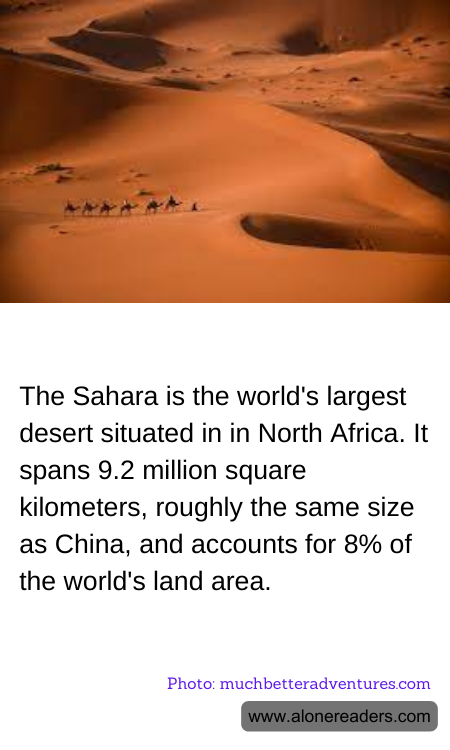
The Sahara Desert, a vast and iconic expanse, commands the landscape of North Africa with its size and overwhelming natural beauty. Covering approximately 9.2 million square kilometers, it is comparable in size to China and represents about 8% of the total land surface of the Earth. This immense region stretches across several countries, including Algeria, Chad, Egypt, Libya, Mali, Mauritania, Morocco, Niger, Western Sahara, Sudan, and Tunisia, making it a significant geographical and cultural zone on the continent.
Characterized by its harsh climate and challenging living conditions, the Sahara is predominantly made up of sand dunes, gravel plains, and rocky plateaus. Despite the sparse rainfall and extreme temperatures that can soar above 50 degrees Celsius (122 degrees Fahrenheit) in the summer and drop to near freezing at night during the winter, the desert is not as lifeless as it might seem. It hosts a variety of life forms adapted to the tough environment, including resilient plants and hardy animals such as the fennec fox, camels, and various reptiles.
Historically, the Sahara has not always been a desert. Geological and archaeological evidence indicates that it once had a much wetter climate. About 5,000 to 10,000 years ago, it was lush with vegetation, and its prehistoric inhabitants left behind rock paintings depicting rivers, forests, and abundant wildlife. Today, these ancient artworks provide a fascinating insight into the region's historical and climatic transformations.
Over centuries, the Sahara has played a crucial role in human civilization. It served as both a crossroads and a barrier to trade and cultural exchange between Africa's Mediterranean coast and sub-Saharan regions. Caravans of camels, also known as "ships of the desert," have navigated the vast expanses of sand, facilitating the trans-Saharan trade networks that exchanged gold, salt, and other commodities, and contributed significantly to the economic and cultural development of the surrounding regions.
In modern times, the Sahara continues to be of great interest not only for its cultural heritage and natural beauty but also for its natural resources. Oil and natural gas, discovered in the latter part of the 20th century, are especially significant for the economies of several Saharan countries. Additionally, the vast, sunny expanse holds potential for renewable energy initiatives, particularly solar energy projects, which could define the desert's future contributions to human societies.
Despite its severe environment, the Sahara remains a subject of intrigue and mystery, a place of extreme conditions that has captivated the human imagination for millennia. Its undeniable influence continues to shape the economic, cultural, and environmental fabric of North Africa and beyond.
