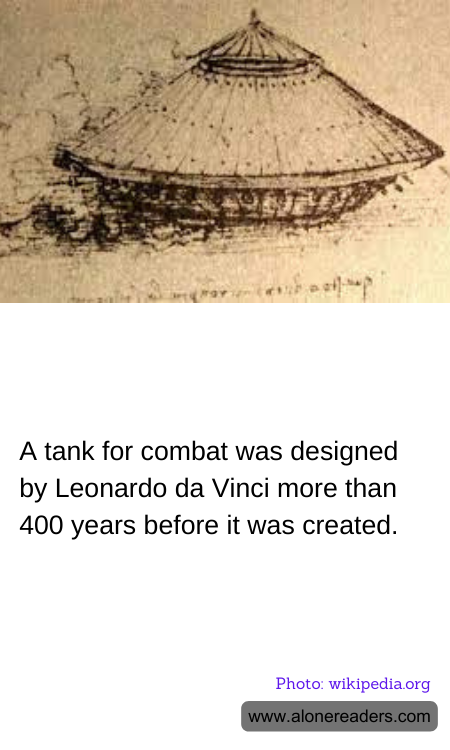
Leonardo da Vinci, a Renaissance polymath whose interests spanned various fields, astonishingly conceptualized the design of a combat tank more than 400 years before such machinery became a reality in warfare. Da Vinci's tank, which was part of a rich trove of military inventions, was designed in 1487, during a time of constant military skirmishes in Italy. His drawings and notes reveal a keen intent to create a vehicle that could move in any direction and was equipped with a plethora of weapons, bearing a striking foresight into the future of armored warfare.
Da Vinci's armored vehicle was designed as a circular platform on four wheels, powered by human force, with men inside turning cranks to move the wheels. The structure was covered with sloped wood, reinforced with metal plates, designed to deflect enemy fire. The vehicle was outfitted with a series of light cannons positioned around the perimeter, intending to shoot at enemy troops at 360 degrees. Da Vinci's design also included peepholes or slits through which the operators could see and presumably, target the enemy.
The tactical thinking behind this invention was to break through the enemy lines, wreaking havoc while offering a protective shield to those operating it from inside. However, despite its innovative design, da Vinci's tank had several practical flaws. The most significant of these was the propulsion system, which would have required considerable human power to move the heavy vehicle, creating a scenario that would likely be inefficient and exhausting for the occupants. Furthermore, had the tank been constructed as planned, rotation of the cranks inside could have led either to a reversal or a halt in movement, depending on the synchronization between the operators, making it tricky to maneuver in a battlefield scenario.
Da Vinci's tank was never built during his lifetime, and it's unclear if it was ever seriously considered by his patrons. It remains a testament to his genius—one that anticipated future military technology by centuries. It was not until World War I, around 1916, that fully operational tanks were developed and deployed, notably by the British and French forces. These modern tanks featured not only more reliable engines but also caterpillar tracks, which significantly improved their mobility over da Vinci's design.
Indeed, while da Vinci's concept did not reach fruition in his own time, it sparks the imagination as an early example of envisioning new technologies that blend mechanics, physics, and tactical warfare strategy. Leonardo's invention illustrates a bridging of medieval warfare tactics with innovative advances in military technology that wouldn't come to full maturation until the 20th century. This underscores his role not just as an artist and scientist, but as one of the early pioneers in the evolution of combat engineering.
