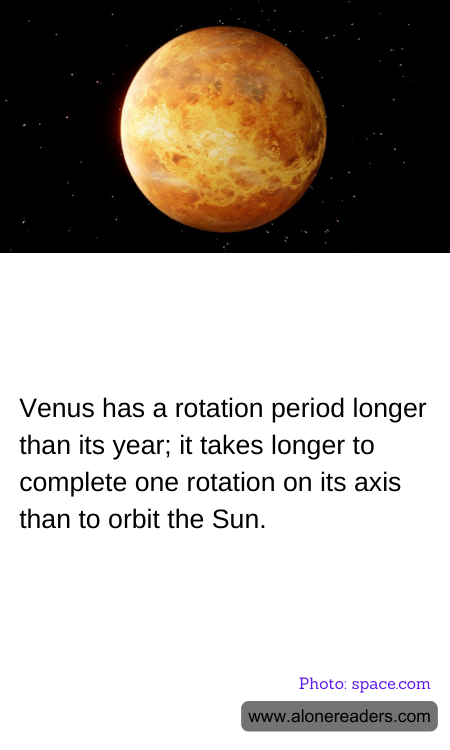
Venus, often referred to as Earth's "sister planet" due to its similar size and proximity, exhibits one of the most unusual characteristics in our solar system – it has a rotation period longer than its year. This means Venus takes longer to rotate once on its axis than it does to complete an orbit around the Sun. To put it in perspective, a single day on Venus lasts longer than a Venusian year.
Venus completes an orbit around the Sun in about 225 Earth days, which is relatively swift compared to Earth's 365-day orbit. However, Venus rotates on its axis very slowly, taking about 243 Earth days to complete one rotation. This slow rotation is retrograde; meaning, Venus spins in the opposite direction to most planets in the solar system. This quirky rotational direction means that on Venus, the Sun would appear to rise in the west and set in the east.
This unusual phenomenon is compounded by the extreme atmospheric conditions on Venus, which features thick clouds of sulfuric acid, making it one of the most hostile environments in the solar system. The atmospheric pressure on the planet's surface is crushing – about 92 times greater than Earth's, equivalent to the pressure found a mile deep in Earth's oceans.
The reasons for Venus’ peculiar rotational characteristics remain a subject of scientific investigation. Several theories suggest that gravitational interactions with the Sun and other planets, as well as the impacts of celestial bodies during the planet's formation period, could have contributed to its slow and retrograde rotation. These unusual dynamics affect Venusian weather patterns, creating winds that whip around the planet at speeds faster than Venus itself rotates.
The study of Venus provides crucial insights not only into other celestial bodies but also into our own planet’s atmosphere and magnetic fields. Understanding why Venus spins the way it does and the implications of its slow rotation help scientists develop better models of planetary atmospheres and dynamics. Despite its inhospitable conditions, Venus continues to fascinate scientists and laypersons alike as a remarkable reminder of the dynamic and mysterious nature of our solar system.
