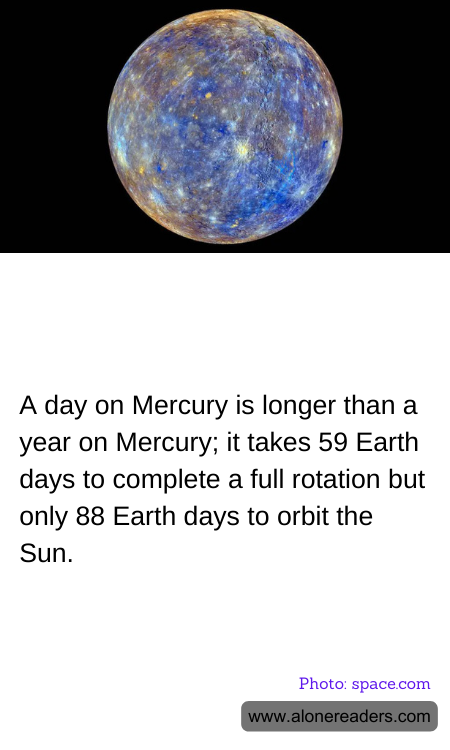
Mercury, the smallest planet in our solar system and closest to the Sun, has some peculiar characteristics when it comes to its rotation and orbit. One of the most fascinating aspects of this rocky planet is its relationship between the length of its day and its year. Remarkably, a single day on Mercury—defined as one full rotation on its axis—takes about 59 Earth days. In contrast, Mercury's orbital period, or its year, takes only about 88 Earth days. This means that a day on Mercury is longer than its year.
This unusual phenomenon is a result of Mercury’s slow rotation in conjunction with its rapid movement around the Sun. Typically, planets in our solar system have days much shorter than their years. For instance, Earth’s rotation period (a day) is 24 hours and its orbit around the sun (a year) is 365 days. However, due to Mercury's unique rotational period and fast orbital speed, the duration from one sunrise to the next on Mercury takes 176 Earth days—effectively making its solar day, or the length of time from one noon to the next, twice as long as its year.
Mercury's slow rotation could be attributed to the Sun's gravitational forces. The intense gravitational pull from the Sun likely caused the planet's rotation to slow down over time, a phenomenon known as tidal locking. In fact, Mercury is in a 3:2 spin-orbit resonance, which means it rotates three times on its axis for every two orbits it makes around the Sun.
These dynamics render Mercury a planet of extremes. Not only does it have the longest day relative to its year in our solar system, it also exhibits drastic temperature fluctuations. Mercury lacks an atmosphere substantial enough to regulate temperature, so while sunlight scorches the surface on the sunlit side up to 430 degrees Celsius, temperatures on the dark side can plummet to minus 180 degrees Celsius.
Understanding Mercury's rotation and orbit offers insights not only into its geological and atmospheric properties but also helps in studying other celestial bodies, including exoplanets, giving scientists clues about planet formation and the dynamics of proximal orbits to stars.
