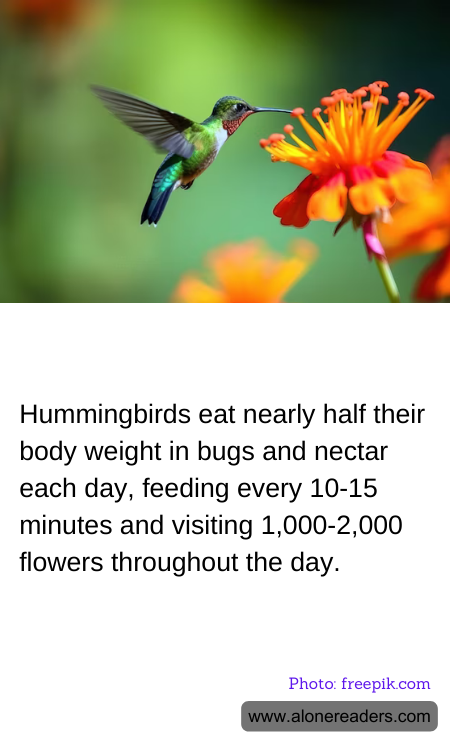
Hummingbirds are among nature’s most fascinating creatures, not just for their iridescent feathers and nimble flight patterns, but also for their extraordinary feeding habits. These tiny birds consume nearly half their body weight in food daily, an impressive feat driven by their incredibly high metabolism. To sustain their energy levels, they feast on a mixture of nectar and insects, engaging in a constant search for sustenance throughout the daylight hours.
Every 10-15 minutes, a hummingbird must eat to support its energetically expensive flying technique. The bird’s hover-feeding approach allows it to sip nectar while suspended in the air, a maneuver that requires immense energy. The primary source of this energy comes from the sugary nectar found in flowers. Over the course of a day, a single hummingbird can visit between 1,000 and 2,000 flowers to drink nectar, using its long, specialized beak and rapid-moving tongue to extract its food.
Besides nectar, hummingbirds also rely on bugs as a crucial part of their diet, providing essential proteins and fats. These can include flies, spiders, and other small arthropods. Catching these tiny insects requires agility and precision, further showcasing the hummingbird’s adept flight abilities. The insects not only balance their diet but also offer a protein-rich supplement to their high-sugar nectar intake, which is necessary for maintaining muscle mass and overall health.
This rigorous feeding regimen is vital, especially considering that hummingbirds undergo long migrations, some spanning over a thousand miles. Their ability to process food quickly and efficiently is a marvel of evolution, allowing them to store fat as an energy reserve for their lengthy journeys. Despite their minute size, hummingbirds have a gigantic appetite and metabolism that is truly a wonder of the natural world, reflecting the extraordinary adaptations of wildlife.
