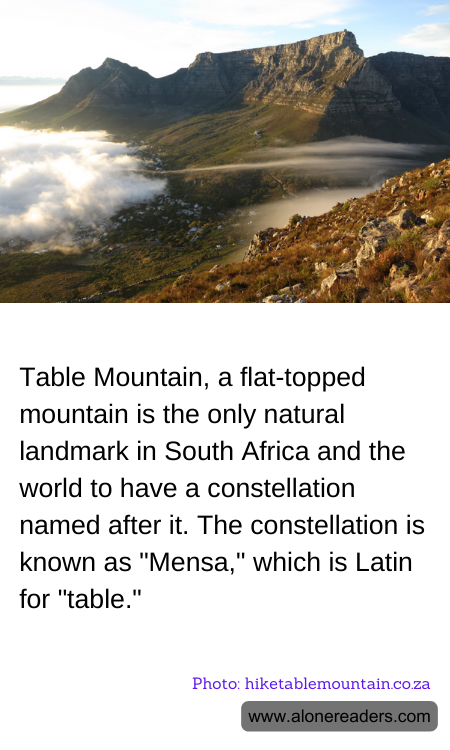
Table Mountain, a prominent landmark towering over the city of Cape Town, South Africa, is not only known for its striking flat-topped silhouette but also for its unique celestial recognition. This geological wonder covers approximately 57 square kilometers and stands about 1,086 meters above sea level at its highest point. The mountain serves as a majestic backdrop to Cape Town and is a significant tourist attraction with numerous hiking trails and the famous Table Mountain Aerial Cableway, which provides breathtaking views of the sprawling landscape below.
In recognition of its iconic status, Table Mountain has an unusual honor in the celestial sphere. It is the only natural feature on Earth to have a constellation named after it. This constellation, known as Mensa, meaning "table" in Latin, was introduced in the 18th century by the French astronomer Nicolas Louis de Lacaille. During his time in South Africa, De Lacaille conducted extensive studies of the southern skies. Inspired by the mountain's distinctive tabletop, he named the constellation Mensa in honor of this South African landmark.
The constellation Mensa is located in the southern celestial hemisphere, making it visible primarily from the southern parts of the Earth. It lies near the South Celestial Pole and is bordered by other constellations like Octans, Chamaeleon, and Volans. Despite its significant naming, Mensa is one of the faintest constellations in the night sky, which makes it a challenge for amateur stargazers to identify.
The naming of Mensa after Table Mountain is a testament to the enduring impression the mountain has left on observers from around the world, illustrating how natural beauty can inspire both terrestrial and astronomical interests. This rare honor highlights the cultural and scientific bridge between exploring our earthly spectacles and the mysteries of the cosmos, emphasizing the universal admiration for significant landmarks and the stories they inspire.
