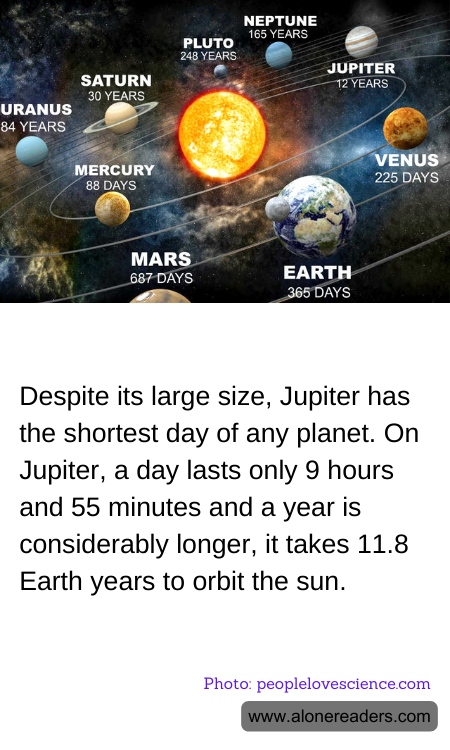
Jupiter, the largest planet in our Solar System, is a behemoth composed predominantly of hydrogen and helium. Its massive size, however, doesn't translate to longer days. In fact, Jupiter has the shortest day of all the planets, with a single rotation on its axis taking just about 9 hours and 55 minutes. This rapid rotation speed is even more remarkable considering Jupiter's size and is a result of its large mass causing the planet to be more flattened at the poles and bulging at its equator.
Contrastingly, Jupiter takes a significant amount of time to complete an orbit around the Sun—about 11.8 Earth years. This vast orbit period defines the length of a year on Jupiter and highlights the vast distances within our Solar System. Jupiter's rapid day-night cycle combined with its lengthy orbital period creates an interesting dynamic where Jovian residents (hypothetical as there are no known inhabitants) would experience thousands of days in a single year.
This fast rotation has profound effects on the planet's weather systems. It contributes to Jupiter's famous bands, formed by different wind speeds in the planet's upper atmosphere. Moreover, it's responsible for the generation of Jupiter’s powerful magnetic field, which is significantly stronger than Earth's magnetic field. This magnetic field forms a gigantic magnetosphere, that protects the planet from solar radiation and cosmic rays, making it one of the most interesting and studied objects in solar magnetic studies.
The complexity and extremes of Jupiter's day and orbital mechanics not only provide a tantalizing glimpse into the dynamics of giant gas planets but also help astronomers and scientists understand similar planets in distant solar systems, offering insights into the behavior and characteristics of exoplanets that may not be observable from Earth. Thus, Jupiter’s unique characteristics play a crucial role in the broader context of planetary science and space exploration.
