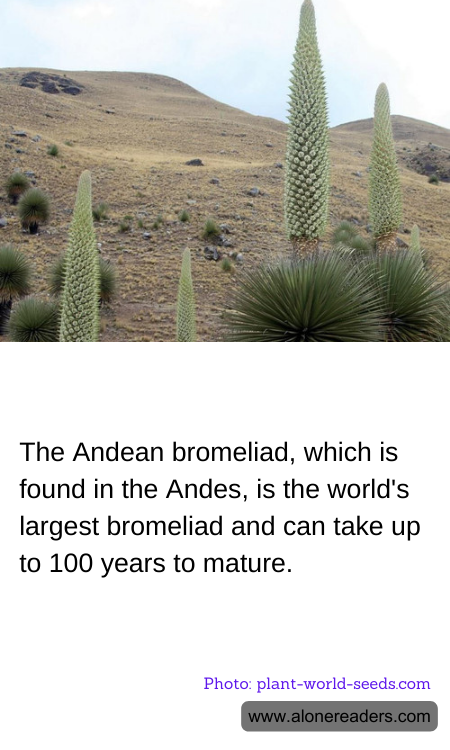
The Andean bromeliad is a remarkable example of the stunning biodiversity found in the Andes Mountains, a major mountain range in South America. As the world’s largest bromeliad, this plant species exhibits unique features and behaviors that are finely adapted to the harsh, variable conditions of its high-altitude environment.
Bromeliads, belonging to the family Bromeliaceae, are known for their striking forms and resilience. The Andean bromeliad, however, sets itself apart due to its enormous size and extremely slow growth rate. This plant can take up to a century to reach maturity, a testament to the patience and perseverance required to survive in its native habitat. Throughout its lifespan, which can extend considerably beyond the point of maturity, the Andean bromeliad contributes significantly to its ecosystem, providing habitat and nutrition to a diverse array of organisms.
The lifecycle of the Andean bromeliad is particularly fascinating. It spends the vast majority of its life in a vegetative state, slowly accumulating resources and growing. Once it reaches maturity, it produces a spectacular inflorescence: a towering flower spike that can rise above the foliage, attracting pollinators such as birds, bats, and insects. After flowering, which may only occur once in the plant's lifetime, it typically dies. This phenomenon, known as monocarpic senescence, underscores the Andean bromeliad's dramatic lifecycle and ecological importance.
The slow growth rate and long maturation period of the Andean bromeliad are likely adaptations to its challenging environment. Located at high elevations, these plants endure cold temperatures, intense solar radiation, and nutrient-poor soils. Their ability to store water in their tightly packed leaves is crucial for survival, as is their capacity to capture nutrients from atmospheric sources, a trait shared by many bromeliads.
Despite its robustness, the Andean bromeliad faces threats from climate change and human activities. Changes in temperature and precipitation patterns could impact its reproductive cycles and survival. Additionally, habitat destruction due to mining and agriculture poses significant risks. Efforts to conserve this plant, and its habitat, are essential to maintain the ecological balance of the Andean regions and the survival of the myriad species that depend on it.
In conclusion, the Andean bromeliad is not just a plant but a cornerstone species within its ecosystem. Its survival and health are closely intertwined with the wellbeing of many other species. Preserving it requires understanding its role and the delicate balance of its mountainous environment. This giant among bromeliads is indeed a natural wonder, embodying the resilience and beauty of the biodiversity it supports.
