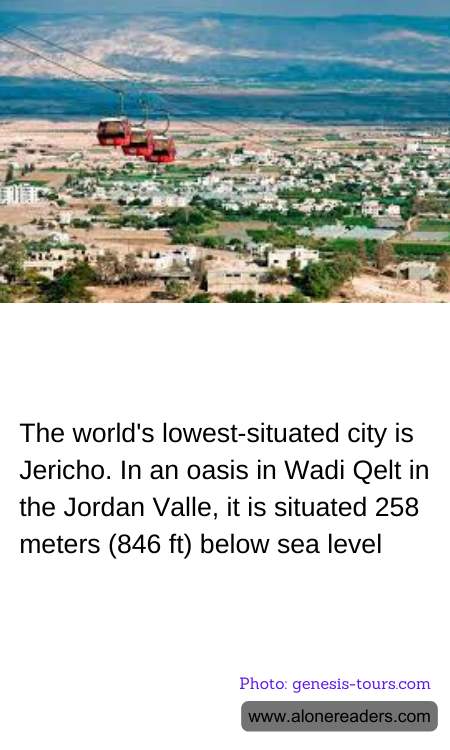
Jericho, often cited as one of the oldest continually inhabited cities in the world, stands out not only for its rich historical tapestry but also for its unique geographical positioning as the world’s lowest city, located 258 meters (846 feet) below sea level. This ancient city, nestled in an oasis in Wadi Qelt in the expansive Jordan Valley, serves as a fascinating study of human settlement, resilience, and architecture through the ages.
The significance of Jericho extends beyond its atmospheric pressure; it's a cultural and historical hub that traces human history back to the Natufian period around 10,000 BCE. Archaeological findings in the area, including remnants of ancient walls and towers, provide evidence of early human innovation and adaptation. These structures are not only some of the earliest examples of human construction but also an indication of the strategic importance of Jericho, situated near the Jordan River and thus a pivotal trading and communal gathering spot through various historical epochs.
In contemporary times, Jericho is a vibrant example of perseverance and cultural melding. Despite its low-lying position, which poses unique challenges especially concerning water levels and agricultural practices, the city thrives agriculturally, thanks to the fertile soil and ample water supply in the oasis. This has led to Jericho being a significant producer of dates and other citrus fruits which are integral both to the local economy and diet.
Moreover, the city's location below sea level offers a unique climate that is typically milder compared to the surrounding desert areas, making it a tourist destination for those seeking historical enlightenment intertwined with natural beauty. The proximity to the Dead Sea also adds to its allure, drawing visitors for both its historical significance and the natural therapeutic properties associated with the Dead Sea’s mineral-rich waters.
Jericho's standing as the lowest city on earth does not just make it a geological curiosity but also a place of profound human connection, linking past civilizations with present-day societies through continuous inhabitation. It underscores how geographic and environmental factors can shape human history and cultural development, serving as a living museum of human resilience and adaptation. This ancient city, by virtue of its depth below sea level, rises above as a testament to the intricate relationship between environment, history, and human survival.
