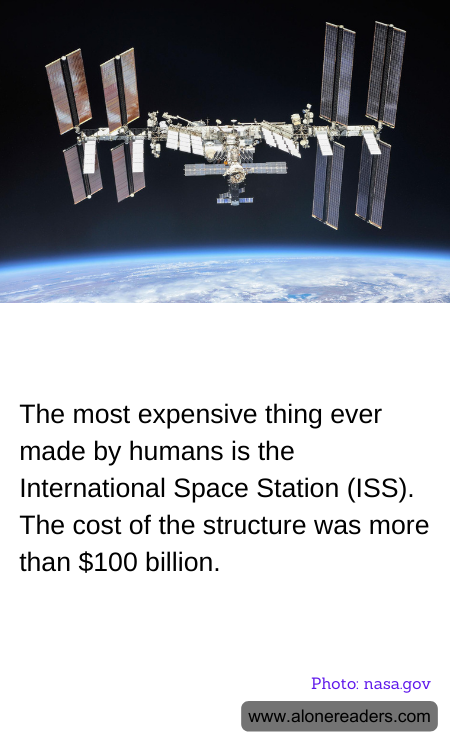
The International Space Station (ISS) stands as a testament to both human ingenuity and colossal financial investment. With a cost that exceeds $100 billion, it is widely recognized as the most expensive object ever constructed. This monumental cost encompasses the expenses of designing, building, and continuously operating the station since its inception. The funding for the ISS has been sourced from multiple countries, with major contributors including the United States, Russia, Europe, Japan, and Canada, making it a global cooperative project.
The ISS provides immense value beyond its astronomical cost. Serving as a microgravity and space environment research laboratory, the station hosts experiments across a variety of disciplines, including astronomy, meteorology, physics, and biology. These experiments cannot be conducted on Earth and are vital for the advancement of science in ways that directly benefit Earth-based technologies and medical treatments. For instance, research conducted on the ISS has led to advancements in pharmaceuticals, water purification systems, and even the way fires are fought.
Moreover, the ISS plays a critical role in the preparation for future space exploration. It functions as a testbed for the technologies and shipboard living conditions necessary for long-term missions to the Moon, Mars, and beyond. Understanding how the human body reacts to long periods of space travel and developing sustainable life support systems are ongoing tasks facilitated by the ISS.
Despite criticism regarding its costs and the shifting priorities of its participating nations, the ISS remains an iconic symbol of international cooperation in space exploration. It not only showcases what can be achieved when nations collaborate, but also acts as a blueprint for future collaborative efforts in tackling global challenges. As it orbits Earth, the International Space Station not only represents a significant financial investment but also continues to be a beacon of scientific hope and collaboration.
