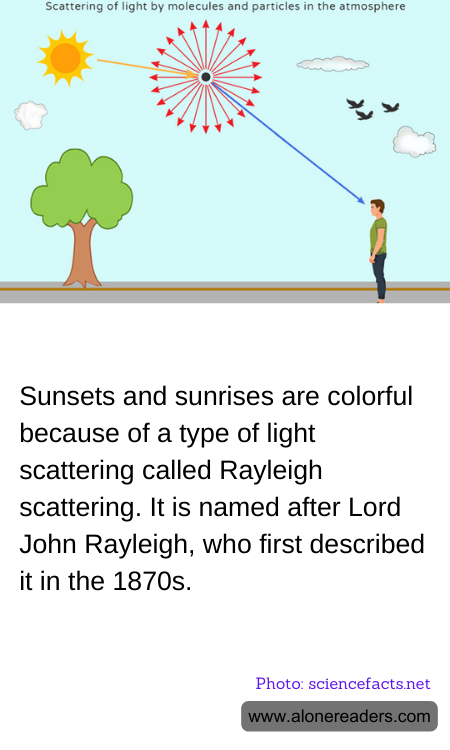
Sunsets and sunrises captivate us with their breathtaking colors, from deep oranges to vibrant pinks, painting the horizon in spectacular hues. This daily natural phenomenon's beauty can be attributed to a fundamental principle known as Rayleigh scattering. Named after the British physicist Lord John Rayleigh, who first described it in the 1870s, this process explains why we see such colorful displays at dawn and dusk.
Rayleigh scattering occurs when sunlight interacts with the Earth's atmosphere. During sunrise and sunset, the sun is positioned low on the horizon, causing sunlight to pass through a greater thickness of the Earth’s atmosphere. The atmosphere is filled with molecules and small particles that scatter short-wavelength light, such as blues and violets, more efficiently than longer wavelengths like reds and oranges. However, because our eyes are not very sensitive to violet hues and because the upper atmosphere absorbs violet light, we see the sky as blue during the day.
As the sun lowers towards the horizon, the path of the light must travel through the atmosphere increases significantly, and this prolonged journey causes even more blue and violet light to be scattered out of the direct line of sight, leaving behind the warmer tones. This extended pathway is precisely why sunsets and sunrises are rich with reds, oranges, and pinks. Additionally, factors such as atmospheric pollution, seasonal changes, and cloud formations can enhance these colors, adding to the dramatic effect of a sunrise or sunset.
Thus, the enchanting palette of dawn and dusk is largely a magnificent display of atmospheric science. Understanding Rayleigh scattering not only explains why the sky evolves through such a wide array of colors throughout the day but also deepens our appreciation for these stunning moments of natural beauty that occur as the earth rotates, bringing the sun below or above the horizon. The science behind this daily spectacle connects us more deeply with the natural world, reminding us of the intricate systems that operate continuously and largely unseen. Through this lens, each sunrise and sunset we witness is a complex interplay of light and matter, orchestrated beautifully by the laws of physics.
