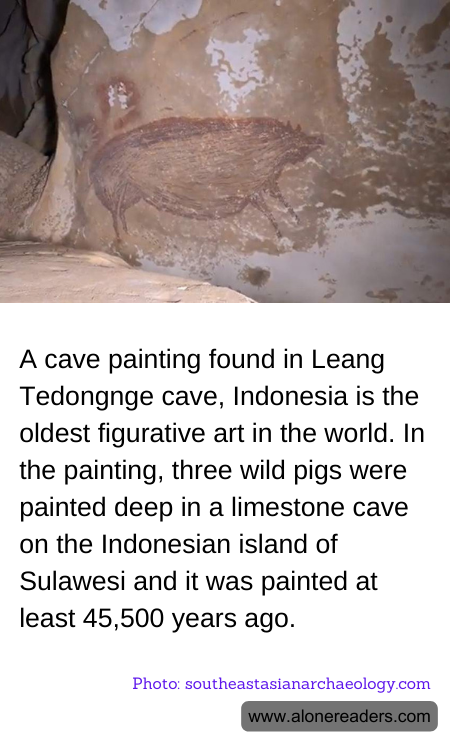
In the secluded Leang Tedongnge cave on the Indonesian island of Sulawesi, an astonishing discovery has been made that pushes the boundaries of our understanding of early human art. Here lies the world’s oldest known figurative painting, a depiction that features three wild pigs, dated to be at least 45,500 years old. This remarkable find not only highlights the sophisticated artistic capabilities of early humans but also offers insights into their environment and cultural practices.
The cave painting is executed in red ochre pigment and depicts a group of Sulawesi warty pigs, a species still native to the region. These pigs are portrayed with a high degree of naturalism, particularly in the portrayal of the fur and the anatomically precise dimensions, suggesting that early humans possessed advanced observational skills and the ability to represent the physical world around them.
What makes this discovery significant is its age. At over 45,500 years old, it predates other known figurative cave paintings by thousands of years, suggesting that humans were engaging in complex artistic expression much earlier than previously thought. This challenges the Eurocentric perspective of the origins of art and indicates that the urge to create representational art was a global phenomenon.
Moreover, the placement of the paintings deep within a dark limestone cave raises questions about the purpose these artworks served. They were likely not created for simple decorative purposes; rather, they might have held spiritual or ritual significance for the artists. Some researchers speculate these images could be linked to early hunting practices or shamanistic beliefs, serving as a sympathetic magic to ensure a successful hunt.
This discovery not only pushes back the timeline of artistic endeavor but also provides valuable context about the cognitive abilities and cultural complexities of early humans in this region. It invites a reevaluation of the narrative that revolves around human development and artistic expression, emphasizing a more inclusive look at history that spans across different continents and cultures. As archeologists continue to excavate and study these early works of art, it becomes increasingly clear that our ancestors were not just survivors but were also sophisticated thinkers capable of complex symbolic expression.
