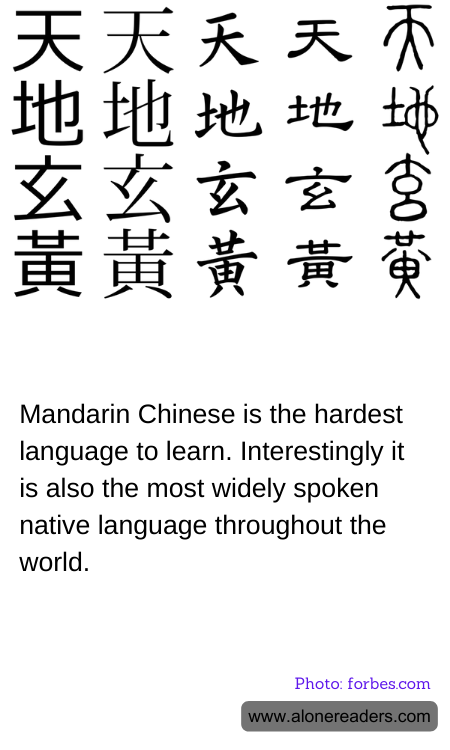
Learning a new language can be a daunting challenge, and when it comes to complexity and difficulty, Mandarin Chinese often tops the list. It's not just the thousands of characters to memorize or the tonal nature of its pronunciation; the language's structure and syntax also present unique challenges to non-native speakers. Despite these obstacles, Mandarin Chinese holds the distinction of being the most widely spoken native language in the world, with over a billion native speakers, primarily in China, Taiwan, and Singapore.
One of the major reasons Mandarin is considered difficult for English speakers, and indeed for speakers of many Western languages, is its use of tones. There are four main tones in Mandarin, and the meaning of a word changes depending on its tone. This tonal system can be quite tricky to master, as the same spelling can represent completely different words when pronounced differently. Additionally, unlike alphabetic languages where letters represent sounds, Chinese characters are logograms, which means each character represents a meaning and/or a sound. This requires learners to memorize thousands of symbols, along with their pronunciations and meanings.
However, Mandarin grammar does have some aspects that can be seen as simpler than those of many European languages. For example, verbs do not conjugate according to tense or number, meaning that one does not have to memorize different verb forms. The concept of tenses is primarily handled by context and the use of temporal markers, sparing learners one common grammatical complexity encountered in many other languages.
Aside from the linguistic features, there are cultural aspects embedded in the language that also need to be understood and appreciated. Chinese characters themselves are often pictorial, encapsulating not just grammatical meaning but also historical and cultural meanings that can provide fascinating insights into Chinese civilization and thought.
Regardless of its challenges, learning Mandarin Chinese offers numerous benefits. It opens up a plethora of professional opportunities, particularly in the fields of international business, diplomacy, and tourism. Moreover, with China's growing influence on the global stage, speaking Mandarin is increasingly becoming a valuable asset in global communication.
Indeed, the vast number of native speakers is itself a testament to the language's global importance. More people speak Mandarin as their first language than any other language in the world. This widespread use not only enhances the practical value of learning the language but also enriches the learning process by offering a deeper engagement with the rich cultural traditions of the Chinese-speaking world.
In sum, while Mandarin Chinese may pose significant learning challenges, its status as the most widely spoken native language in the world, coupled with the rich cultural and professional rewards it offers, makes it a worthwhile endeavor for those seeking to expand their linguistic horizons.
