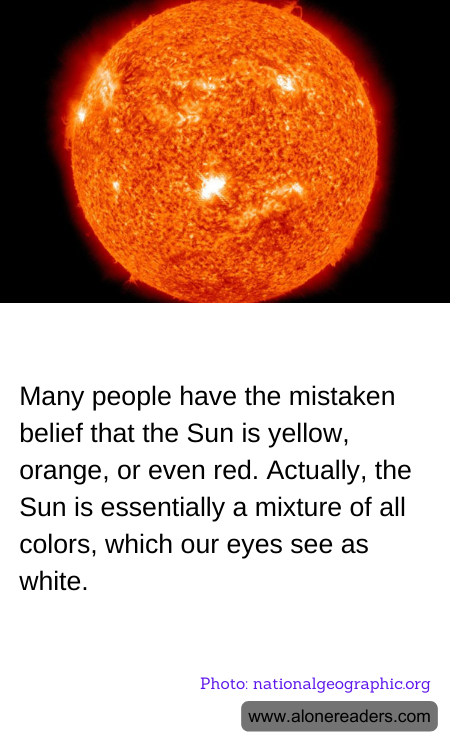
The common portrayal of the Sun as yellow or orange, often vividly illustrated in art and media, belies its true nature. In reality, the Sun is essentially a massive incandescent ball radiating light of all colors. This broad spectrum of light, when combined, is perceived by the human eye as white.
The reason the Sun appears yellow to us from Earth's surface is due to the Earth’s atmosphere. When sunlight enters our atmosphere, it collides with molecules and small particles, which scatter shorter wavelengths of light, such as blues and violets, more than longer wavelengths like reds and yellows. This phenomenon, known as Rayleigh scattering, is also why the sky appears blue during the day. What remains in the direct path of the Sun’s light to our eyes is predominantly the longer wavelengths, hence the Sun's yellowish appearance.
When observed from space, where there is no atmosphere to scatter the light, the Sun indeed appears as a white star. Its true color is more accurately represented in this environment, reaffirming the fact that the Sun emits light across the visible spectrum in a nearly uniform manner. This is consistent with what we know about the Sun's temperature and emissions, primarily reflecting a balance across the spectrum rather than favoring any particular color.
Understanding the Sun’s actual color helps in comprehending more about how light interacts with Earth’s atmosphere and can alter the perceived colors of celestial bodies. Moreover, it aids in the realistic interpretation of images from outer space, highlighting the differences in perception that result from Earth-bound observations versus those made from space. Such knowledge is not only fundamental in physics and astronomy but also enriches our general appreciation of the natural world.
