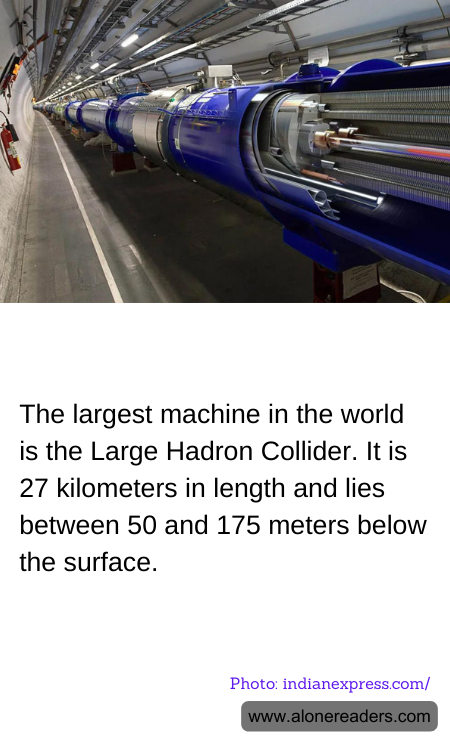
The Large Hadron Collider (LHC) stands as a monumental achievement in the field of particle physics and is renowned for being the world's largest and most powerful particle accelerator. Spanning an impressive 27 kilometers in circumference, the LHC is strategically nestled between 50 and 175 meters beneath the surface, near Geneva, on the border between France and Switzerland. This colossal machine is operated by the European Organization for Nuclear Research, commonly known by its French acronym CERN.
The primary function of the LHC is to allow physicists to test the predictions of different theories of particle physics, including the renowned Standard Model, and to further our understanding of fundamental particles and forces. It achieves this by accelerating two high-energy particle beams, usually protons or lead ions, close to the speed of light in opposite directions. These beams are then made to collide at various points around the accelerator ring, which is equipped with detectors that analyze the particles created by the collisions.
One of the most significant achievements of the LHC was the discovery of the Higgs boson in 2012, a particle that was predicted by the Standard Model and plays a crucial role in giving mass to other elementary particles. This discovery was a landmark event in the field of particle physics, confirming a key element of the Standard Model, and it earned the Nobel Prize in Physics in 2013 for theorists François Englert and Peter Higgs.
The construction of the LHC was a massive engineering challenge. The tunnel in which it resides was originally built for its predecessor, the Large Electron-Positron Collider. The LHC uses a vast array of superconducting magnets and accelerating structures to drive the particles along its tunnel at incredible speeds. Maintaining the operational conditions necessary for its functioning, such as an ultrahigh vacuum close to that found in outer space and the cryogenic temperatures needed to keep its magnets superconducting, is an ongoing challenge.
In addition to its scientific goals, the LHC also drives advancements in other fields such as computing through the necessity of processing, storing, and distributing the vast quantities of data it generates. This has led to significant developments in distributed computing, notably the Worldwide LHC Computing Grid.
As the LHC moves into future phases of experimentation, with upgrades for increased luminosity and energy, the global scientific community watches with anticipation for further insights into the most basic constituents of the universe and the forces that shape it. This machine not only represents a pinnacle of human curiosity and technological capability but also acts as a bridge connecting theories of the incredibly small and the vast universal scales.
