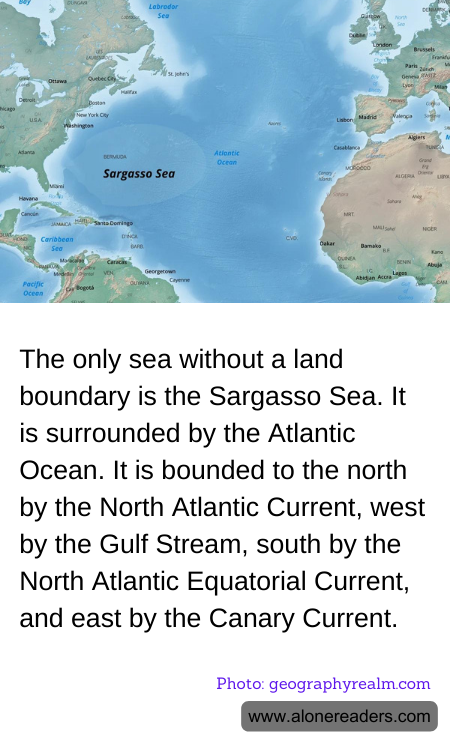
The Sargasso Sea, a unique and mysterious body of water, is the only sea on the planet without a land boundary. This sea is completely encircled by ocean currents and situated in the middle of the North Atlantic Ocean. To the north, it is bounded by the North Atlantic Current, to the west by the powerful Gulf Stream, to the south by the North Atlantic Equatorial Current, and to the east by the Canary Current. These ocean currents form a dynamic boundary that isolates the Sargasso Sea from its Atlantic neighbors, creating a distinct ecological region.
Named after the Sargassum seaweed that prolifically floats on its surface, the Sargasso Sea plays a crucial role in marine biodiversity. The floating mats of seaweed are not just a defining characteristic of the sea; they provide an essential habitat for a variety of marine species. Young sea turtles, for instance, are known to use these dense weed mats as shelter and a feeding ground, hiding from predators until they are mature and strong enough to venture into open waters. Additionally, the Sargasso Sea serves as a spawning ground for European and American eels, contributing significantly to the life cycle of these species by providing a nursery for their larvae.
The sea's isolation and unique ecological characteristics make it an area of scientific interest, particularly concerning studies on biodiversity and the impacts of climate change. Researchers are keen on understanding how the changing climate might affect the sea's currents, seaweed distribution, and by extension, the marine life dependent on this environment.
However, the Sargasso Sea faces environmental threats, including pollution and the accumulation of plastic waste in its waters. This pollution poses a danger to its delicate ecosystem, which relies heavily on the balance maintained by its surrounding currents and native seaweed. Efforts to protect and preserve the Sargasso Sea are crucial in maintaining its biodiversity and the global marine environment. Such efforts underline the importance of international cooperation in marine conservation, acknowledging that the health of even a boundary-less sea like the Sargasso has far-reaching impacts on global marine biodiversity and the overall health of the world’s oceans.
