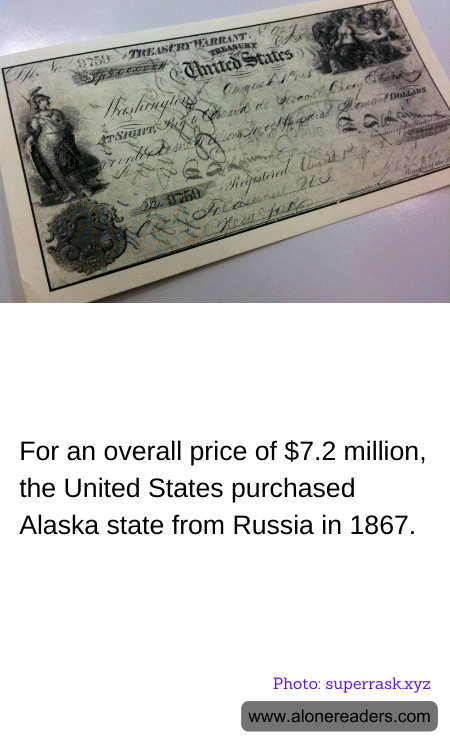
On March 30, 1867, the United States completed one of the most significant real estate deals in history, purchasing the vast territory of Alaska from the Russian Empire. The deal was negotiated and signed by U.S. Secretary of State William H. Seward and the Russian Minister to the United States, Eduard de Stoeckl. The purchase price was $7.2 million, equivalent to roughly two cents per acre, which today sounds like an unbelievably good bargain.
At the time, however, the deal was met with skepticism and ridicule. Critics in the United States labeled it as "Seward's Folly" or "Seward's Icebox," mocking what they saw as a foolish purchase of a frozen wasteland with no apparent value. The public perception was largely shaped by a lack of understanding of Alaska's resources and potential.
Yet, the acquisition of Alaska turned out to be enormously beneficial for the United States. The territory is rich in natural resources including oil, gas, gold, and other valuable minerals, and it has become a vital area for American fishing and tourism industries. The discovery of gold in the late 1890s led to the famous Klondike Gold Rush, which further demonstrated Alaska’s immense economic potential and helped change perceptions about the value of the purchase.
Alaska's strategic geographical location has also played a crucial role in national defense. During World War II, it was a critical staging area for U.S. military operations in the Pacific. The importance of Alaska’s location continues in the context of global geopolitics, serving as a forefront of American presence in the Arctic.
Moreover, the purchase of Alaska also demonstrated American expansionist ambitions towards the west and the Pacific, reinforcing the notion of Manifest Destiny that guided much of U.S. policy during the 19th century.
Today, Alaska is viewed as a treasure trove of natural beauty and resources. Its vast landscapes attract millions of tourists each year, drawn by its unique wildlife, stunning vistas, and the aura of the untouched wilderness. The initial investment of $7.2 million has paid off many times over, proving that what might have once been seen as a folly was indeed one of the most astute investments in American history. This transaction not only expanded the territorial boundaries of the United States but also added immeasurably to its wealth, resources, and strategic capabilities.
