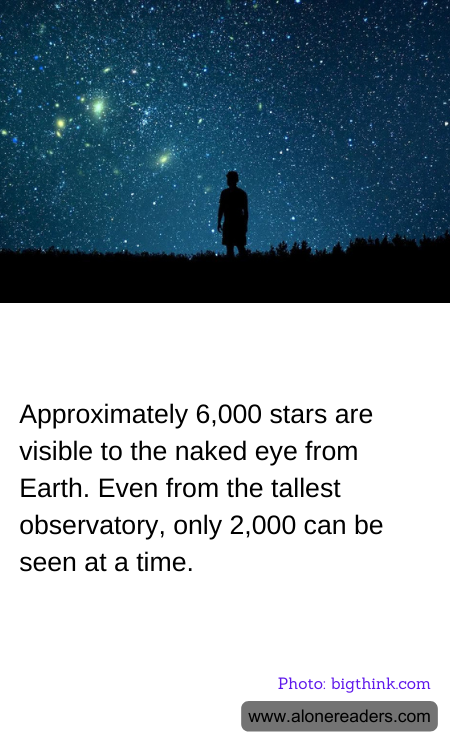
Stars have fascinated humanity since time immemorial, acting as both a celestial calendar and a navigational tool. On a clear, dark night, about 6,000 stars can be discerned with the naked eye from various vantage points on Earth. However, due to the Earth's curvature and the presence of the horizon, an observer can only see about half of these stars at any given time. Consequently, even from the most advanced and elevated observatories, one can observe a maximum of 2,000 stars at once.
This limitation is primarily due to the vastness of the night sky, which envelops the Earth in a complete sphere. Observatories, despite their often impressive altitudes and sophisticated technology, cannot alter this basic geographic and celestial constraint; they too are limited by the Earth’s horizon at their particular location. However, these facilities greatly enhance our capability to see deeper into space and observe celestial phenomena that are otherwise invisible to the naked eye, such as distant galaxies and nebulae.
The number of visible stars is further influenced by factors such as light pollution, atmospheric conditions, and the observer's visual acuity. Urban areas, for instance, suffer from significant light pollution, which obscures the visibility of many stars. This phenomenon is responsible for the dramatic difference in the number of visible stars in rural versus urban settings. Meanwhile, atmospheric conditions such as fog, dust, or smog can also hinder star visibility.
Even with these limitations, the visible stars offer a glimpse into the vastness of our universe. Every star we see is part of the Milky Way galaxy, which is just one of billions of galaxies in the universe. Each visible point of light represents a sun, possibly with its own system of planets, offering endless possibilities for discovery and wonder.
In essence, while we can only see a fraction of the stars from any given point on Earth, each star observed opens a doorway to the infinite expanses of our cosmos, reminding us of both our significant place in the universe and our limited perspective from within it.
