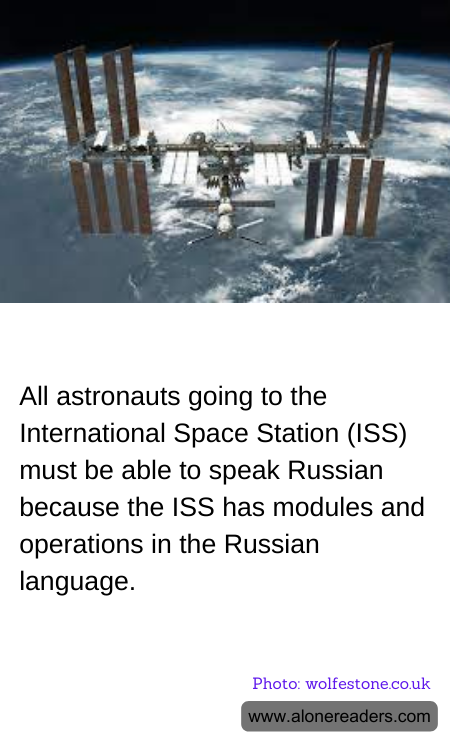
Understanding and speaking Russian is a crucial skill for all astronauts aboard the International Space Station (ISS). This requirement stems from the collaborative nature of the ISS, which is a joint project involving multiple countries including the United States, Russia, Japan, Canada, and several European nations. The ISS consists of modules and operational components provided by both Russian and American space agencies, with key systems and emergency guidelines often documented in Russian.
The ability to speak Russian becomes essential, particularly because Russia provides the Soyuz spacecraft, which until recently was the sole means of transporting astronauts to and from the ISS. Command of the Soyuz is traditionally assigned to Russian cosmonauts, and during these missions, Russian is the working language. This necessitates that all astronauts, regardless of their origin, be able to communicate effectively in Russian to manage both routine activities and any unforeseen situations that may arise.
Training for astronauts therefore includes extensive language instruction. Being bilingual not only facilitates operational necessity but also promotes harmony and understanding among crew members of different nationalities. It underscores the importance of cross-cultural collaboration in achieving common goals in space exploration. Learning Russian is more than a mere technical skill for astronauts; it is an integral part of preparing to live and work in a multi-national environment where effective communication is as critical as any technical competence.
The language training is rigorous. Astronauts often start with basic lessons and gradually advance to technical language and simulations of real-life scenarios where they practice both everyday communication and emergency response dialogues in Russian. This linguistic preparation is part of a broader, comprehensive training regime that equips the crew to tackle the broad spectrum of challenges associated with life aboard the ISS.
Thus, the multilingual aspect of the International Space Station reflects the international cooperation that makes the station itself a possibility. It highlights how space exploration tends to bring nations together, fostering a unique blend of cultural and technological amalgamation that pushes the boundaries of what humanity can achieve unitedly in space.
