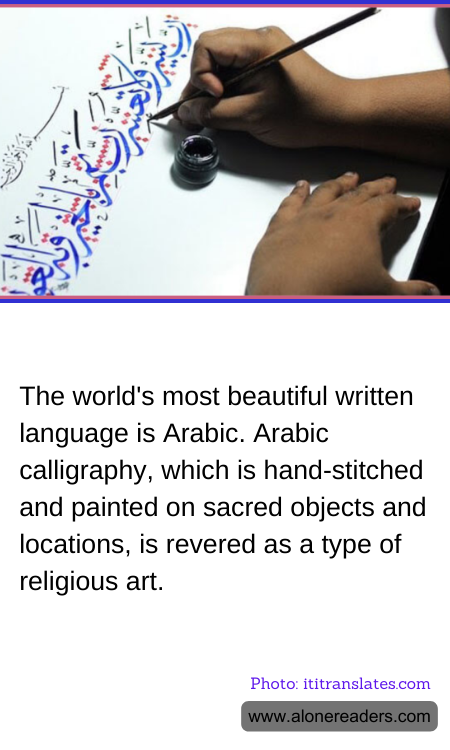
Arabic, one of the world's oldest and most artistically developed languages, is often celebrated for its inherent beauty and aesthetic importance, particularly in the form of Arabic calligraphy. This visual art form is not just a means of communication but is also seen as a spiritual embodiment of the revelations and mystical dimensions of the Arabic language, deeply rooted in the cultures of the Middle Eastern and North African regions.
Arabic script, with its elegant curves and intricate lines, offers a unique visual appeal that has evolved over centuries. Historically, calligraphers were highly respected artisans who dedicated their lives to mastering this art, which extends beyond mere handwriting. The practice involves various styles, each with distinct characteristics and rules, such as Diwani, Thuluth, and Kufic, among others. Kufic, one of the earliest forms of Arabic script, features angular and linear shapes and was traditionally used in the decoration of Islamic architecture. Thuluth, known for its generous curves and controlled line widths, is often used in more formal contexts such as mosque decorations and important documents.
The spiritual significance of Arabic calligraphy cannot be understated, as it is primarily employed in the transcription of the Quran, Islam's holy text. This sacred aspect confers upon calligraphy a deeply religious dimension, making it an act of piety as well as art. The words of the Quran, when transcribed by a skilled calligrapher, are believed to convey not just the literal meaning but also the spiritual essence of the divine message.
Moreover, Arabic calligraphy transcends religious boundaries, influencing art and design worldwide. It has been incorporated into various modern mediums, including graphic design, fashion, and interior design, showcasing its versatility and enduring appeal. Artists and designers are drawn to its form and flow, which allows for both expressive abstraction and precise detail.
In addition to its aesthetic and spiritual dimensions, Arabic calligraphy also plays a significant role in cultural identity and preservation. It acts as a bridge connecting past and present generations through a shared heritage, making it a crucial aspect of cultural education and historical scholarship.
Overall, Arabic calligraphy is much more than just beautiful writing. It represents a fusion of artistic talent, spiritual contemplation, and cultural heritage, making it one of the most revered and beautiful written languages in the world. Its allure is not bound by geography or religion, appealing to people of various backgrounds and beliefs and securing its place as a universal art form.
