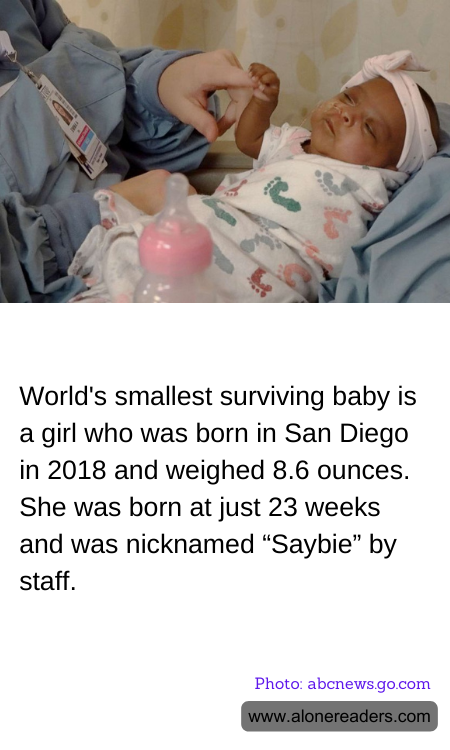
In a remarkable testament to medical science and human resilience, the world's smallest surviving baby, a girl nicknamed "Saybie" by hospital staff, was born in San Diego in December 2018. Weighing just 8.6 ounces, her birth weight was comparable to a large apple. Saybie's premature arrival at just 23 weeks presented a host of challenges that required immediate and intensive care to ensure her survival.
Saybie's journey began in the neonatal intensive care unit (NICU) at Sharp Mary Birch Hospital for Women & Newborns, one of the premiere facilities for neonatal care. Her critical condition demanded round-the-clock attention from a dedicated team of specialists and cutting-edge technology to monitor her every breath, heartbeat, and developmental progress. The medical team faced numerous hurdles due to her size and the immaturity of her organs. Her skin was so fragile and her body so tiny that even the simplest care had to be meticulously planned and gently administered.
Despite the daunting odds, Saybie's fight and spirit were strong. Over the months, she began gaining weight and growing stronger each day. Her progress surprised even the seasoned medical professionals who cared for her. Saybie's ability to thrive in such extreme circumstances transformed her from a medical statistic to a beacon of hope for premature babies worldwide.
After spending nearly five months in the NICG, Saybie was discharged from the hospital, a momentous occasion celebrated by her family and the hospital staff. Her discharge was not just a medical success; it was a milestone in neonatal care, showing what is possible with the combination of advanced medicine and the dedicated care of health professionals.
Saybie's story is not only about medical achievement. It is also a heartening reminder that every baby, no matter how small, brings with immense possibilities. As the smallest surviving baby to date, she highlights the advances in neonatal care and the potential for survival and healthy development in infants born at the edge of viability. Her journey continues to inspire families with premature babies and the medical community alike, pushing the boundaries of what is achievable in neonatal medicine.
