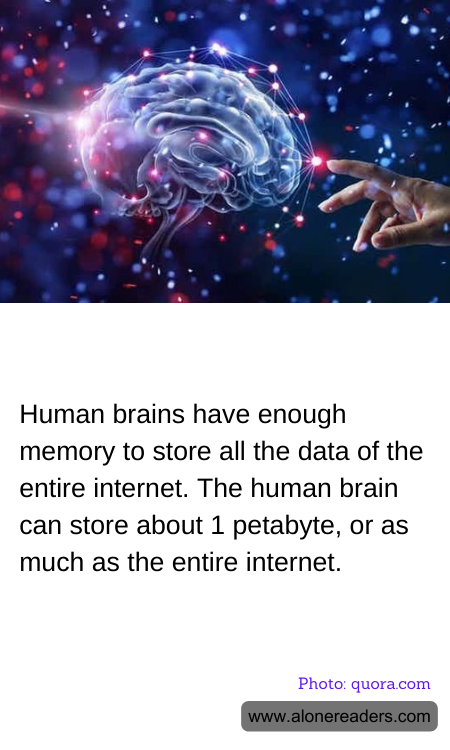
The human brain is an incredible organ, often compared to the most sophisticated computers. One of the facets frequently highlighted is its capacity to store information, which is said to be around 1 petabyte. To put this into perspective, 1 petabyte is roughly equivalent to about 20 million four-drawer filing cabinets full of text, or approximately 13.3 years of HD-TV video. In the grand scale of digital data, this number approximates the vast amount of data found on the internet.
However, comparing the brain’s memory capacity to the internet should be done with caution. The brain does not function like a hard drive where data is neatly stored and equally easy to retrieve. Memory in the human brain is complex and involves various types of information being encoded, stored, and interlinked through associations in different ways. This complex orchestration allows for creativity, intuitive leaps, and emotional context that the internet's data storage simply cannot match.
Furthermore, the analogy might be misleading in terms of scale. As of the late 2020s, estimates suggest that the size of the internet, in terms of data created, kept, and consumed, is far beyond 1 petabyte, reaching hundreds if not thousands of zettabytes—a zettabyte being one billion terabytes. The exponential growth of data generation means that the internet is continuously expanding at a rate which is difficult for most to even conceptualize.
Therefore, while the claim that the human brain can store as much information as the internet highlights the impressive capacity of our neural systems, it is not accurate when we consider the literal sizes involved. Instead, such comparisons serve better as metaphors to illustrate the vast and nuanced capacities of our brains compared to digital data systems. These analogies help underscore the remarkable nature of human memory, which encompasses not just data storage, but the intricate and dynamic processes of learning, recalling, and forgetting. The brain's ability to process and interpret this information with depth and emotional insight is what truly sets it apart from any existing technology.
