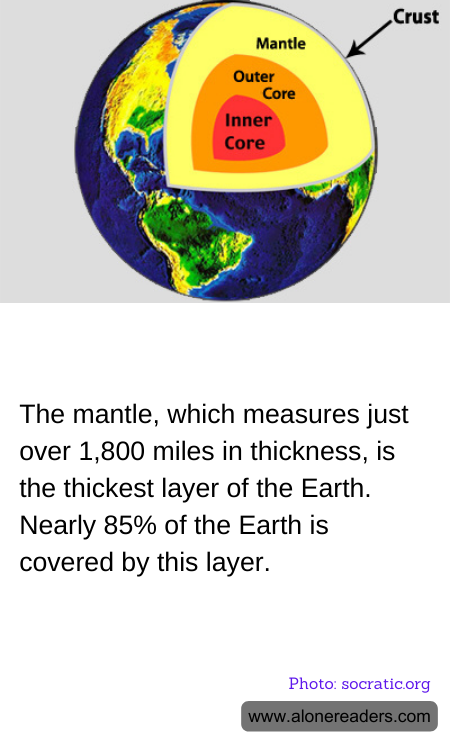
Beneath the Earth's crust lies the mantle, a colossal layer extending over 1,800 miles in thickness, making it the thickest layer of our planet. It constitutes nearly 85% of Earth's total volume, highlighting its significance in Earth's structure. This layer is primarily composed of silicate rocks rich in iron and magnesium, differentiating it in composition from the overlying crust.
The mantle is divided into the upper and lower mantles. The upper mantle extends from just below the crust to a depth of about 410 miles. This part of the mantle is involved in tectonic activities and is partially molten, which enables the movement of tectonic plates above. The lower mantle stretches from around 410 miles deep to about 1,800 miles deep, right above the outer core. In this region, the material is much hotter and exposed to higher pressure, resulting in a stiffer and denser layer than the upper mantle.
Temperature within the mantle varies from approximately 500 to 900 degrees Celsius near the crust, to over 4,000 degrees Celsius closer to the boundary with the outer core. These extreme temperatures contribute to the convective movements within the mantle, where hot material rises towards the surface, cools, and then sinks back down. This convective flow is crucial because it drives the motion of tectonic plates located on the Earth’s crust above.
The understanding of the mantle is not just academic; it has practical implications for various fields, including geology, volcanology, and seismology. The processes within the mantle play a critical part in shaping the Earth's landscape, influencing volcanic activity, and causing earthquakes. Insights into the nature of the mantle can help predict these natural events and potentially mitigate their impacts on humanity.
Thus, the mantle is not merely an immense layer lying beneath our feet; it is a dynamic, intensely active part of Earth that plays a pivotal role in the geological phenomena that shape our world. By studying this layer, scientists can gain insights into the past, present, and future of our planet.
