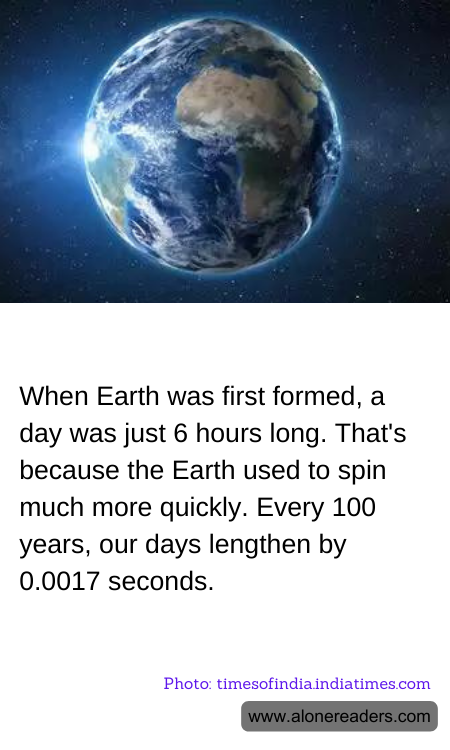
When Earth was first formed over 4.5 billion years ago, it presented a very different face than the one we are familiar with today. Among the most striking differences was the length of a day, which was a mere six hours long compared to our current 24-hour cycle. This faster spin was due to the residual energy released during the violent collisions and accretion processes that characterized Earth's early formation, including the colossal impact believed to have created the Moon.
Over the millennia, the Earth’s rotation gradually began to slow down. This deceleration is primarily attributed to the tidal forces between the Earth and its moon. The gravitational pull between the Earth and the Moon serves to slow down the Earth’s rotation speed while causing the Moon to drift slightly further away from the Earth at about 3.8 centimeters per year. Known as tidal friction, this process involves the transformation of Earth's rotational energy into heat, thereby gradually slowing the Earth's spin.
At the current rate, our days are getting longer by approximately 0.0017 seconds every hundred years. This might seem negligible, but over vast spans of geological time, it accumulates significantly. For example, during the time of the dinosaurs, a day on Earth lasted about 23 hours. This alteration in the length of days has implications for the natural rhythms and evolutionary norms of Earth's ecosystems. It affects everything from the patterns of sleep in animals to the photosynthesis cycles in plants.
In addition to tidal forces, other factors such as geological events like earthquakes and glacial isostatic adjustments (the redistribution of mass as ice sheets melt) can also influence the speed of Earth’s rotation. However, these changes are usually more abrupt and less predictable than the steady influence of lunar tides.
Despite these slow changes, for all practical purposes, human lifespans are too short to experience any significant alteration in the length of a day. Technological advancements have allowed scientists to accurately measure these minuscule changes, ensuring precise timekeeping that accounts for such fluctuations over long periods. This meticulous accounting is crucial in fields like astronomy and navigation, where precise time measurements are essential.
As the centuries continue to pass, the evolution of the Earth's rotation will remain a fascinating topic for scientists, offering insights not only into the dynamics of our planet but also into the broader behaviors of planets and moons throughout the universe.
