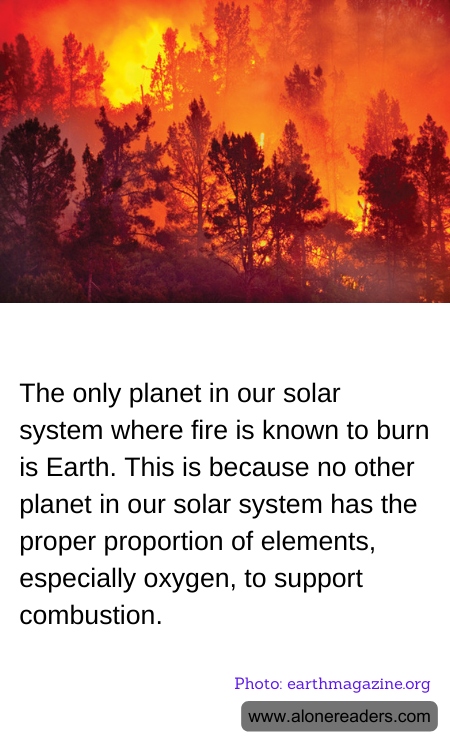
Fire, as a natural phenomenon, is exclusive to Earth within our solar system, primarily due to its unique atmospheric composition. For a fire to occur, three essential elements are necessary: a fuel source, heat, and an oxidizing agent typically oxygen. Earth's atmosphere contains about 21% oxygen, which is ideal for supporting combustion processes.
No other planet in our solar system has a similar atmospheric makeup. For instance, Mars, with an atmosphere comprised mostly of carbon dioxide, lacks sufficient oxygen for fuel to burn as it does on Earth. Venus, though it has an atmosphere that is dense and rich in carbon dioxide, similarly lacks the necessary oxygen and is far too hot with surface temperatures sufficient to melt lead; conditions that preclude the kind of oxidation reactions we associate with burning here on Earth.
Moreover, the unique presence of life on Earth also contributes substantially to the occurrence of fire. Plants, a primary fuel source for fires, along with the oxygen released during photosynthesis, enable combustion to happen naturally. Lightning strikes or volcanic eruptions often serve as natural ignition sources, further facilitating these processes. In contrast, other planets do not have life forms that could produce organic combustibles or influence the atmosphere in a way that supports burning.
Jupiter and Saturn, which are gas giants, possess atmospheres rich in hydrogen and helium, with no solid surfaces where typical Earth-like fires could ignite and sustain. Their extreme pressure and temperature conditions further alienate them from the terrestrial combustion scenario.
In essence, Earth's unique blend of life, atmospheric oxygen, and natural ignition sources like lightning makes it the sole planet in our solar system where fire can naturally occur and sustain. This singular capability highlights not only the uniqueness of our planet but also underscores the intricate balance of natural elements that foster life and phenomena such as fire.
