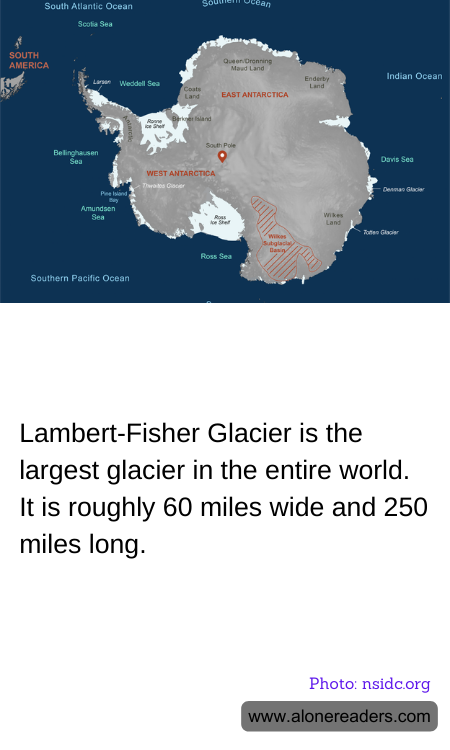
The Lambert-Fisher Glacier, a colossal ice stream, is not just a natural spectacle but also an intriguing subject of study due to its massive scale and ecological significance. Located in East Antarctica, this glacier is indeed the largest glacier in the world, especially when considering its area combined with the underlying subglacial basins that extend its influence even further into the Antarctic continent.
Spanning approximately 60 miles in width and 250 miles in length, the Lambert-Fisher Glacier serves as a critical component of the Antarctic ice sheet by channeling vast amounts of ice from the interior of the continent to the coast. The glacier merges into the Amery Ice Shelf, a large floating ice platform in Prydz Bay, which is a significant area for research because of its potential insights into global sea level rise.
The massive size and the volume of ice it contains make the Lambert-Fisher Glacier an essential piece of the Earth's climate system. Its health and behavior provide clues about the impacts of climate change on polar environments. Changes in its velocity and ice thickness, which are constantly monitored by satellites and field studies, are crucial in understanding the balance of the Antarctic ice sheet.
Moreover, the scientific exploration of the Lambert-Fisher Glacier involves studying the glacier's basal properties, such as its subglacial geology and hydrology. These factors play pivotal roles in its movement and melting patterns. Researchers use a variety of instruments, including ice-penetrating radar and satellite imagery, to study these characteristics. This data is vital not only for predicting future sea level rise but also for understanding broader geological processes that could have implications far beyond Antarctica itself.
Undoubtedly, the Lambert-Fisher Glacier is also a striking symbol of the wild, extreme conditions prevalent in Antarctica, drawing attention to the urgent need for environmental conservation and highlighting how interconnected our planet's ecosystems are. As the Earth's climate continues to change, the fate of the Lambert-Fisher Glacier will be a crucial indicator of the shifts occurring in our global environment, making continued observation and study of this glacial giant not just fascinating but imperative.
