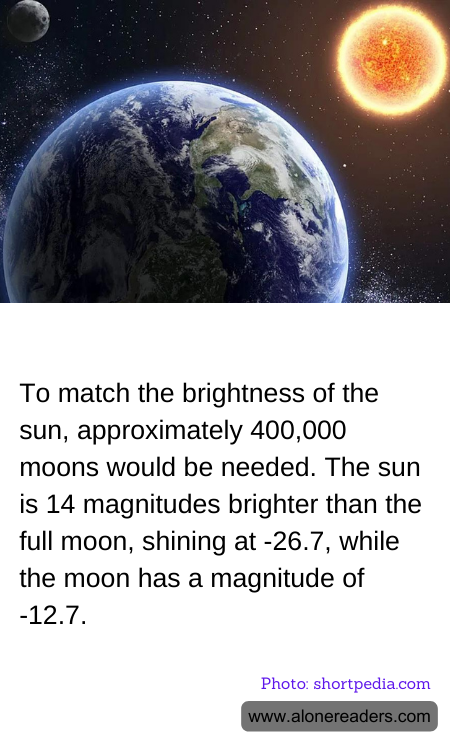
The vast differences in brightness between celestial bodies like the sun and the moon are fascinating and illustrate the enormality of our universe. To match the radiant intensity of the sun, it would take about 400,000 moons. This statistic stems from the difference in their magnitudes, a scale used to measure the brightness of objects in the sky viewed from Earth. The sun, for instance, has a magnitude of approximately -26.7, making it the brightest object in our sky. In comparison, the full moon shines with a magnitude of -12.7.
Magnitude, a logarithmic scale, was originally designed such that each decrease by 1 point represents an increase in actual brightness by about 2.5 times. Thus, the fourteen-point difference between the sun and the moon signifies that the sun is about 400,000 times brighter than the moon. This immense difference is not only a reflection of the sun’s greater intrinsic brightness but also its larger size and closer proximity to Earth compared to other stars.
Understanding these values puts into perspective the vast scales and distances in our universe and helps us appreciate the powerful forces and sources of energy within it. It’s intriguing to imagine the combined light of 400,000 moons and how still it would be overshadowed by the blazing glory of just one sun. Such comparisons deepen our appreciation of the dynamics and balances in our solar system, emphasizing the extraordinary circumstances that make life on Earth possible.
