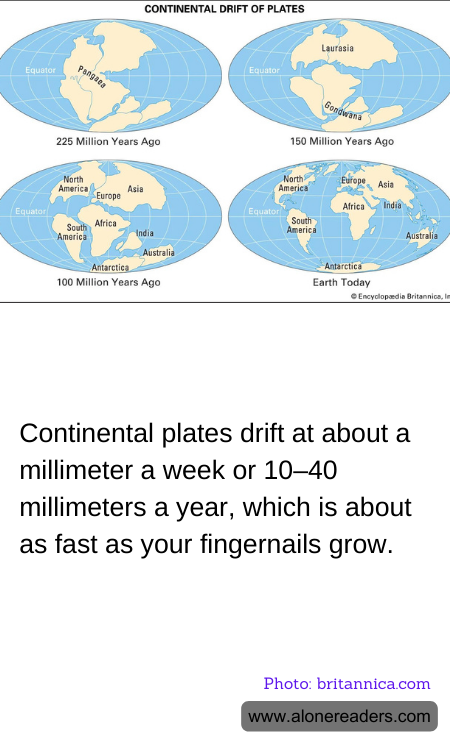
The slow yet relentless movement of continental plates is a fascinating aspect of Earth's geology. Much like the subtle growth of human fingernails, these massive slabs of earth's crust creep along at a similarly gradual pace, approximately 10–40 millimeters per year. This might sound trivial, but over millions of years, this movement reshapes continents and oceans, leading to profound transformations in Earth's geography and biodiversity.
The notion that continents drift dates back to the early 20th century when meteorologist Alfred Wegener proposed his theory of continental drift. Despite initial skepticism, this theory has been substantially validated by modern science, particularly through the study of plate tectonics which provides a comprehensive explanation of how and why these plates move. The movement is driven by the intense heat in Earth's core, causing molten rock to circulate in the mantle beneath the crust. This convection-like process makes the plates shift about, crashing into one another, pulling apart, or grinding past each other, often with dramatic effects.
These tectonic shifts are responsible for a range of natural phenomena, from the creation of mountain ranges and oceanic trenches to volcanic activity and earthquakes. For example, the collision of the Indian Plate with the Eurasian Plate has given rise to the Himalayas, the world's highest mountain range. On the other hand, the San Andreas Fault in California exemplifies a transform boundary where two plates slide past each other, a movement that periodically results in significant seismic activity.
Furthermore, plate tectonics play a crucial role in the carbon cycle and Earth's climate over geologic timescales. The slow cycle of rocks through the mantle and crust regulates the carbon dioxide between the ocean-atmosphere system and the lithosphere, impacting global temperatures and climate change.
The pace of continental drift is a poignant reminder of the dynamic yet steady rhythm of our planet's geological clock. Even though it occurs on a scale and speed that is almost imperceptible to us, its effects are monumental, shaping the very ground beneath our feet and the world we live in. Thus, while we may take for granted the stability of our continents, beneath us is a constant, slow dance of immense geological forces that continues to mold our planet's surface and influence its ecological futures.
