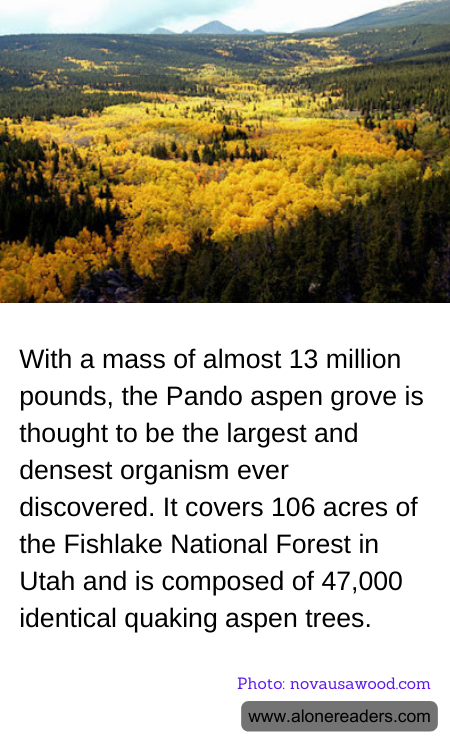
The Pando aspen grove, located in Utah's Fishlake National Forest, is a remarkable example of natural wonder and biological unity. Often referred to as "The Trembling Giant," this grove spans approximately 106 acres and consists of about 47,000 genetically identical quaking aspen trees. What makes Pando particularly fascinating is that it is not just a group of individual trees but a single organism connected by a massive underground root system. Each tree, or 'stem,' that arises from this root system is a clone of its neighbors, creating a forest that is essentially one giant living entity.
Estimated to weigh nearly 13 million pounds, Pando is believed to be one of the heaviest, if not the heaviest, living organisms on Earth. Its age, though hard to determine precisely, is estimated to be thousands of years old, making it also one of the oldest known living organisms. The name "Pando" itself stems from the Latin for "I spread out," a fitting description of its expansive root network that continuously sends up new shoots, thus enabling its survival over millennia.
Pando's existence is not just a curiosity; it holds significant ecological importance. As a vast storehouse of genetic uniformity, it is an excellent example of clonal reproduction in plants, offering insights into plant resilience and stability. Moreover, it plays a crucial role in its ecosystem, influencing and maintaining local biodiversity and soil stability. The aspen trees provide habitat and food for a variety of wildlife, from birds to large mammals like deer and elk, which depend on the grove for survival.
However, despite its robustness and age, Pando faces threats from human activities, including development, and natural adversaries like pests and diseases. Overgrazing by wildlife and cattle, which inhibits the growth of new shoots, also poses a significant risk to Pando's sustainability. Conservation efforts are crucial to ensure that this extraordinary organism continues to thrive. Researchers and forest managers are actively working on strategies to protect Pando, including fencing off vulnerable areas and managing the deer population to enable young shoots to grow without being eaten.
Studying and preserving Pando is not only about saving a single organism but about understanding ecological connectivity and resilience. As Pando provides critical insights into ecosystems and the complex interactions within them, it underscores the delicate balance necessary to sustain life in all its forms. By protecting such unique natural phenomena, we ensure the continuation of natural history and gain crucial ecological knowledge that can help address broader environmental challenges.
