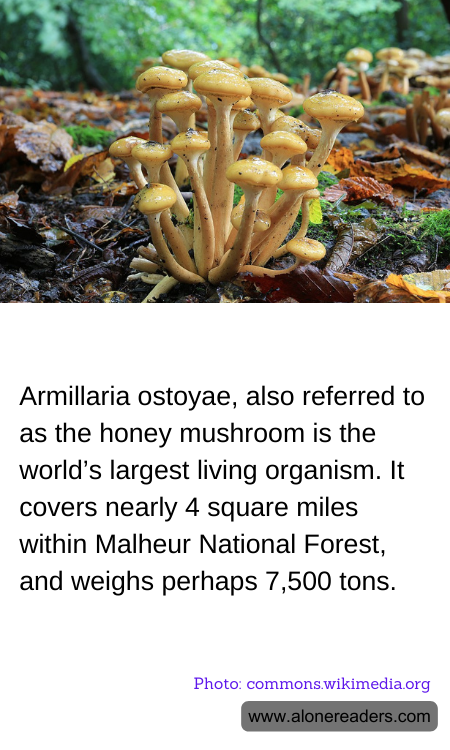
Armillaria ostoyae, commonly known as the honey mushroom, holds the title for the world's largest living organism by area. This remarkable fungus extends over approximately 4 square miles within the lush expanses of Malheur National Forest in Oregon. Astonishing in its magnitude, it is estimated to weigh around 7,500 tons. The honey mushroom is not just a giant in terms of size, but also in terms of its age, with estimates suggesting it could be over 2,400 years old, making it one of the oldest living organisms as well.
The growth of this fungal giant is fundamentally different from what one might expect of a single, solid organism. Armillaria ostoyae spreads underground through an expansive network of rhizomorphs, which are root-like structures that absorb nutrients from the soil. These rhizomorphs invade and decompose the wood of conifer trees, contributing to the mushroom's sustenance and growth. Above ground, the fungus produces clusters of honey-colored mushrooms during the autumn, which are its fruiting bodies.
This massive organism is a marvel for biologists and ecologists, providing profound insights into fungal life cycles and their ecological impacts. The Armillaria ostoyae plays a significant role in its ecosystem by decomposing dead wood and recycling nutrients, which are crucial processes for forest health. However, it can also be a formidable pathogen for forests, causing root rot in trees which can lead to widespread tree die-offs.
The scope and complexity of Armillaria ostoyae challenge our conventional views on what constitutes an individual organism. Its discovery and continued study prompt discussions in scientific communities about the definitions of life, individuality, and the interconnectedness of nature's systems. This gigantic mushroom encapsulates the intricate balance of cooperation and competition that characterizes much of life on Earth.
Despite its scale, many people may walk through parts of the Malheur National Forest without ever realizing they are atop a superorganism that has quietly thrived for millennia. Armillaria ostoyae remains a subject of fascination and is a poignant reminder of the hidden wonders of the natural world. As research continues, this organism will likely continue to teach us about longevity, survival, and the ecological complexities of fungal life.
