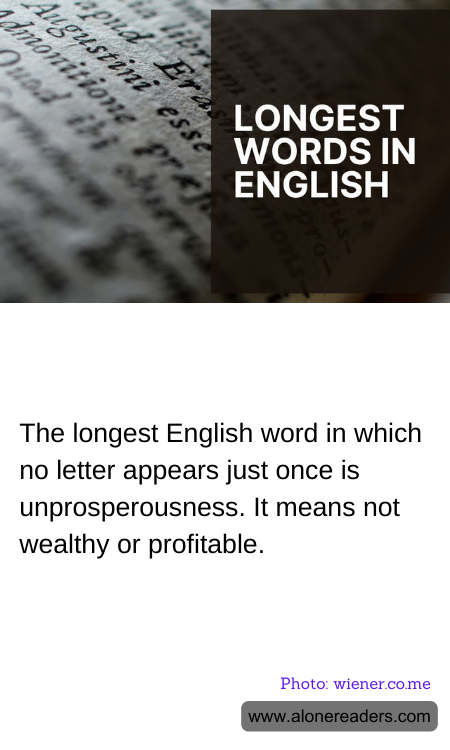
The longest English word where no letter is used just once, "unprosperousness," weaves a distinctive linguistic tale, embedding economic struggle in its fourteen-letter sprawl. Reflecting a stark deviation from wealth and profitability, unprosperousness encapsulates a state or condition where success, especially in financial terms, is absent. Far from being an everyday term, its usage typically resonates in more formal or literary contexts where the nuances of its multiple repeating letters can mirror repeated financial failings or ongoing lack of growth.
In examining the composition of "unprosperousness," one can't help but marvel at the intricate balance of letters, ingeniously repeated to avoid the singularity of any character. The sheer length and structure of the word demand a bit more cognitive effort to grasp and retain, subtly mirroring the complexity and persistence of the problematic situations it often describes. This linguistic characteristic may not be immediately obvious, but it plays a subtle, understated role in emphasizing the prolonged and recurrent nature of unprosperous encounters.
Moreover, the word "unprosperousness" serves as a fascinating case study for enthusiasts and scholars of the English language. It showcases the depth and adaptability of English vocabulary, reflecting both the capability to pinpoint specific states of human experience and the playful complexity of word formation. Such words enrich conversations and texts, providing nuanced descriptions that simpler words cannot always convey. In literary contexts, for instance, unprosperousness can offer a rhythmic and phonetic richness to poems or prose, while in socioeconomic discussions, it might help articulate extended periods of economic downturn or stagnation without oversimplification.
Ultimately, unprosperousness is more than a linguistic curiosity; it is a reminder of the power of language to capture the multifaceted contours of human life. Whether used in economic analysis or explored in academic lectures about morphology, the word holds its ground as both a signifier of distress and a testament to the complex beauty of English orthography and semantics.
