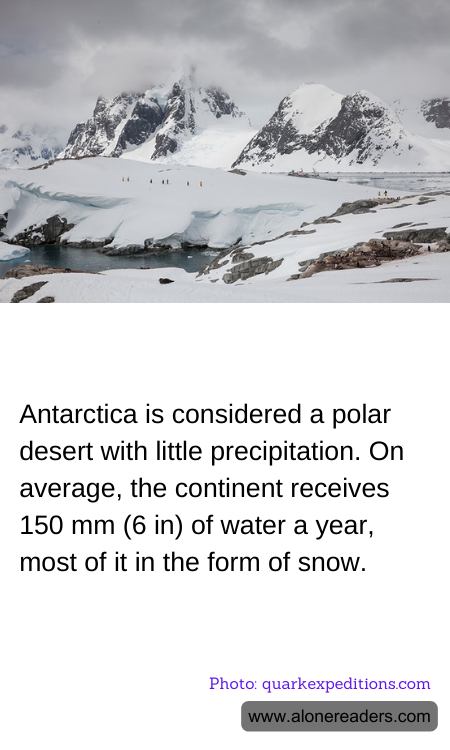
Antarctica, the coldest and southernmost continent on Earth, is often referred to as a polar desert due to its exceptionally low levels of precipitation. Receiving an annual average of only about 150 mm (6 inches) of water, predominantly in the form of snow, it is one of the driest regions in the world. This minimal precipitation is due to the cold temperatures that persist throughout most of the year, which significantly reduce the moisture-carrying capacity of the air.
The continent's climate is the key factor behind its classification as a desert. Antarctica's interior is colder and drier than its coastlines, yet even the relatively milder coastal regions receive very little moisture. The scarcity of precipitation contributes to the stark, icy landscapes that characterize the continent, dominated by ice sheets that can be as thick as 4.7 kilometers (2.9 miles) in some places. These ice sheets contain about 60 percent of the world's fresh water, locked away in frozen form.
Despite its harsh climate, Antarctica plays a crucial role in the Earth’s climate system. The continent's high albedo, the measure of how much sunlight is reflected by a surface, helps to regulate global temperatures by reflecting a significant portion of the sun's rays back into space. Additionally, the formation of sea ice around the continent each winter has important implications for global ocean circulation patterns, impacting climates far beyond the Antarctic region.
The unique weather patterns and climate conditions of Antarctica have also made it an invaluable location for scientific research. Studies conducted on the continent have led to important discoveries about climate change, meteorology, and Earth's history. Ice cores drilled from the deep ice sheets, for example, contain air bubbles that trap ancient atmospheres, providing scientists with detailed records of past climate conditions.
Despite its seemingly inhospitable environment, Antarctica is home to various forms of life that have uniquely adapted to survive in extreme conditions. From microbial life forms to larger species like penguins and seals, these organisms demonstrate remarkable resilience, thriving in one of the toughest climates on Earth.
Understanding Antarctica's environmental conditions is not only crucial for studying global climate change but also for appreciating the delicate balance of ecosystems that exist on our planet. This polar desert, while barren and remote, holds keys to unlocking mysteries about our world's past and future climate trajectories.
