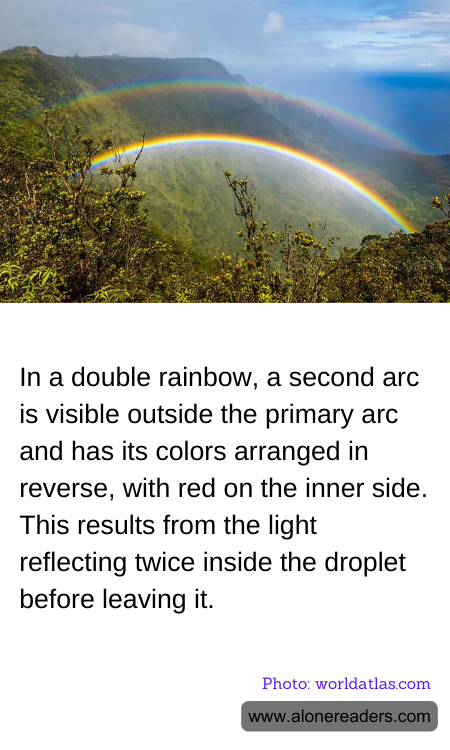
A double rainbow is a captivating natural phenomenon that occurs when sunlight is refractively dispersed into its component colors after entering water droplets, resulting in a spectrum of light appearing in the sky. In this fascinating display, the second arc stands out as it is positioned outside the primary arc and showcases the colors in reverse order, with red on the inner side and violet on the outside, opposite to the primary rainbow.
This reversal of colors is due to an additional reflection of light within the water droplets. When sunlight strikes a raindrop, some of the light refracts into the droplet, reflects off the interior surface, and refracts out again. In the case of the primary rainbow, light is internally reflected once inside the droplet. However, for the secondary rainbow, light undergoes two internal reflections. This extra reflection causes the colors to invert.
Moreover, the additional reflection in the formation of the secondary rainbow also results in a dimmer appearance compared to the primary arc. This is because with each internal reflection, more light is lost. Additionally, the secondary rainbow often appears to have a broader and softer band of colors due to the increased dispersion of light.
The sky between the primary and secondary rainbows often appears darker than the surrounding sky, an area known as Alexander's band. This phenomenon occurs because the additional light reflections in the secondary rainbow divert light from this region.
The occurrence of a double rainbow is a serene and rare spectacle, influenced by various atmospheric conditions, including the size of the raindrops and the angle of the sunlight. The magic of witnessing a double rainbow lies not only in its visual beauty but in the intricate physics behind its formation, highlighting the elegant interplay between light and nature.
