In ancient Rome, numerical calculations were a vital part of commerce, engineering, and daily administration. However, contrary to what one might expect, the iconic Roman numerals that we learn in school today were not used for such calculations. Instead, the Romans relied on a more practical tool for their mathematical operations: the abacus.
The Roman numeral system, while perfectly suitable for inscriptions and recording purposes, is not conducive to calculating by hand. Numerals like I, V, X, L, C, D, and M represent the numbers 1, 5, 10, 50, 100, 500, and 1000, respectively. Given their non-positional nature and the absence of a zero, performing arithmetic operations with these symbols is cumbersome and prone to errors. It was simply not pragmatic for daily calculations, particularly those involving large numbers or complex transactions.
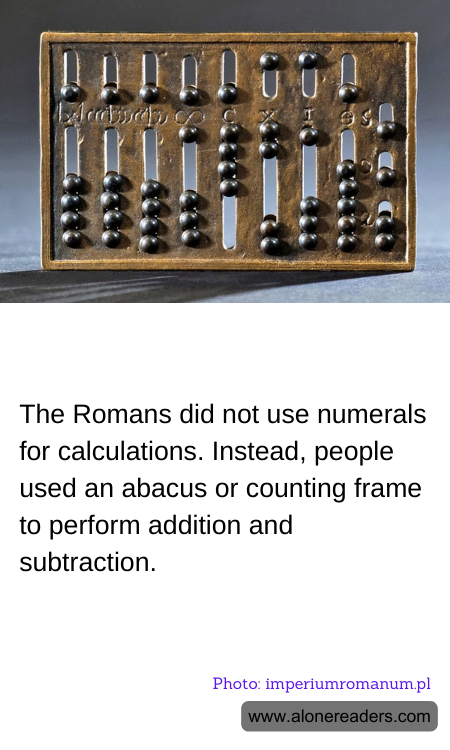
Enter the abacus, commonly known in Rome as the "calculi" or little stones. The Roman abacus was a counting frame typically constructed from materials like wood or metal, featuring grooves in which stones or other markers slid back and forth. This apparatus allowed for the efficient handling of arithmetic operations. The beads in the abacus represented different values depending on their position along the frame, introducing a form of positional notation that was more adaptable and quicker for calculations than the use of Roman numerals.
This counting device was widely used by merchants, tax collectors, and other officials who needed a reliable method for computation. The abacus offered an intuitive and visual means of performing addition, subtraction, and with more skilled use, multiplication and division as well. Its design varied somewhat but generally aligned with the needs and preferences of its user.
The adoption and use of the abacus highlight an important aspect of Roman culture. They were practical people who excelled in areas such as engineering, military tactics, and administrative organization. When confronted with the limitations of their numeral system for calculation purposes, they turned to technology—the abacus—thus enabling more efficient record-keeping and financial management.
Though less known in popular culture compared to the grand architectural feats and political history of Rome, the usage of the abacus is a testament to the pragmatism of the Roman people. It played a crucial role in the economic infrastructure of one of history's most powerful empires, allowing for a streamlined process in commerce and administration, long before the advent of more sophisticated calculating tools like the modern calculator.
