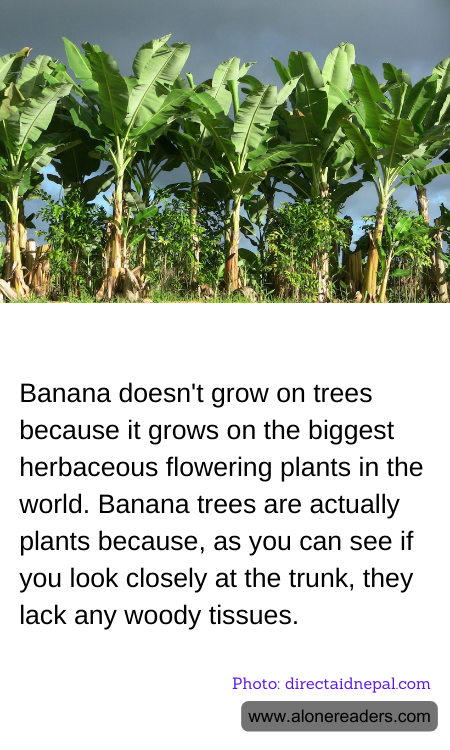
Bananas are among the most popular fruits on Earth, yet most people are mistaken about their origin. Contrary to common belief, bananas do not grow on trees. Instead, they grow on what is actually the world's largest herbaceous flowering plant. This misconception arises because the plants closely resemble a tree structure and are commonly referred to as banana trees. However, they are scientifically classified as herbs, much like smaller garden varieties.
The banana plant, known scientifically as Musa, belongs to the Musaceae family. What appears to be a tree trunk is in fact a "pseudostem" made from the overlapping bases of the plant's large leaves, not from true woody tissue as found in trees. This pseudostem can reach heights of up to 2-8 meters (6-26 feet), which adds to the tree-like misconception.
Each pseudostem can produce a single bunch of bananas, after which it dies. However, the root system remains alive and will produce new pseudostems. Typically, a new pseudostem is already in the growing phase before the death of the old one, enabling a continuous cycle that allows for annual harvesting if conditions are favorable.
Botanically speaking, bananas are actually considered berries. Each banana plant bears fruits that develop from the female flowers, and remarkably, they do so without the need for pollination. The fruits naturally contain seeds, but the varieties commercially cultivated for consumption are seedless mutants and reproduce asexually via vegetative propagation. This method involves growing new plants from cuttings of the rhizome, known as suckers, ensuring the genetic uniformity of banana crops.
From a cursor glance, the towering height and trunk-like structures make it easy to see why many think bananas grow on trees. However, understanding the true nature of the banana plant not only enhances our knowledge of botany but also reminds us of the fascinating diversity of plant life adapted to different ecological niches around the world. Such knowledge is essential for the effective cultivation and conservation of one of the world's most beloved fruits.
