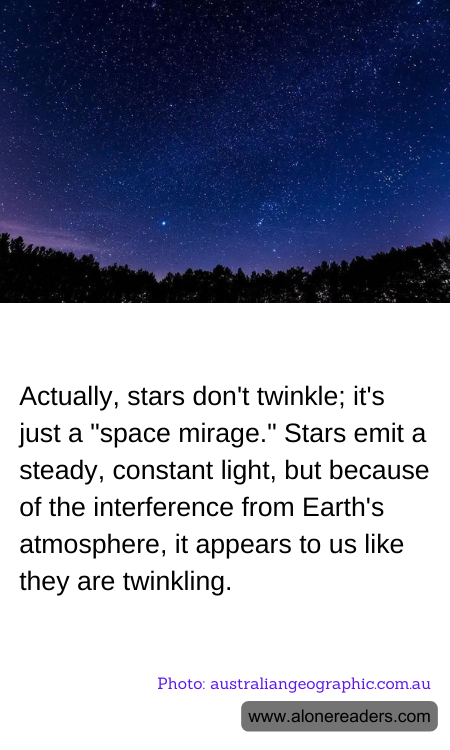
Stars, those distant luminous bodies in the night sky, may seem to flicker and flash due to a phenomenon often described in nursery rhymes as "twinkling." However, the reality is that stars themselves do not naturally twinkle. Instead, what we observe from Earth is an optical effect caused by Earth’s atmosphere. The science behind this fascinating illusion lies in the way light travels and how it interacts with various media, including the atmospheric layers of our planet.
Stars emit a steady, constant stream of light. As this light makes its way through the vastness of space, it does so uninterrupted. However, once starlight reaches the upper layers of Earth's atmosphere, it begins to encounter turbulence and variations in air density and temperature. These atmospheric inconsistencies act like a lens, bending, refracting, and scattering the light in various directions. This phenomenon, known scientifically as atmospheric scintillation, is similar to the shimmering effect observed when light passes through different layers of air above a hot surface, like a road or desert.
From our vantage point, the alteration in the path of the starlight results in the appearance that stars are changing in brightness and position, hence the twinkle effect. Furthermore, different colors of starlight may be bent different amounts due to their wavelengths, which can sometimes lead stars to change color as they twinkle, enhancing the visual spectacle.
The effect of twinkling is more pronounced for stars that are lower in the sky as their light passes through more atmospheric layers compared to stars overhead. Planets, on the other hand, appear steadier in the sky. This is because planets in our solar system are much closer to Earth compared to stars and present a larger angular diameter. Thus, the effects of atmospheric scintillation are averaged out across their apparent size, making them appear less twinkly and more stable.
Understanding the true nature of why stars twinkle enriches our appreciation of the night sky and highlights the dynamic interface between Earth’s atmosphere and the cosmos. It reminds us that our perception of the universe is often shaped by the complex and beautifully intricate layers of our own planet’s envelope.
