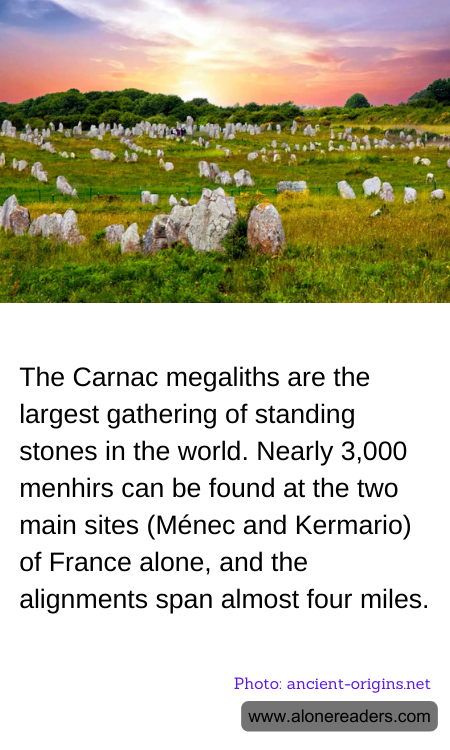
The Carnac megaliths, located in Brittany, France, represent one of the most extensive and enigmatic collections of prehistoric standing stones in the world. These ancient structures, primarily composed of menhirs—large upright stones—are a fascinating testament to the architectural ingenuity and spiritual complexity of Europe's Neolithic people. Nearly 3,000 menhirs are spread across two primary sites, Ménec and Kermario, with the arrangements covering a stretch almost four miles long.
The origin and purpose of the Carnac stones remain subjects of speculation and debate amongst archaeologists and historians. Estimated to have been erected between 4500 BC and 3300 BC, the stones are thought to have served various functions, ranging from astronomical alignments to religious or ceremonial purposes. Some theories suggest that the linear arrangements align with the sun during solstices and equinoxes, indicating a sophisticated understanding of astronomy.
The Ménnosticulations are particularly striking due to their sheer number and orderly configuration. At the Ménec site, eleven lines comprising over 1,000 menhirs run for more than a kilometer. Moving eastward, the Kermario site includes even larger stones, some towering as high as four meters, lined up in ten rows. Another intriguing installation is the nearby Tumulus of Kercado, a mound of earth covering a burial chamber, topped with a large stone slab and believed to be older than the pyramids of Egypt.
Visiting the Carnac megaliths is like stepping into a grand, silent library of stone, each piece possibly encoding stories and beliefs of a long-gone era. Despite numerous studies, the technology and methods used for transporting and erecting these massive stones remain as mysterious as the stones' original purpose. In recent years, the area has attracted not only scholars but also tourists and spiritual seekers, all drawn by the mystique and beauty of these prehistoric monuments.
The French authorities managing the site have implemented measures to protect the megaliths from the pressures of modern tourism. Access to the stones is restricted during certain periods of the year to prevent degradation and to maintain the site's integrity. For those interested in prehistoric architecture and ancient civilizations, the Carnac megaliths offer a compelling glimpse into humanity's distant past, providing both a connection to our Neolithic ancestors and a poignant reminder of the enduring human impulse to create and to commemorate.
