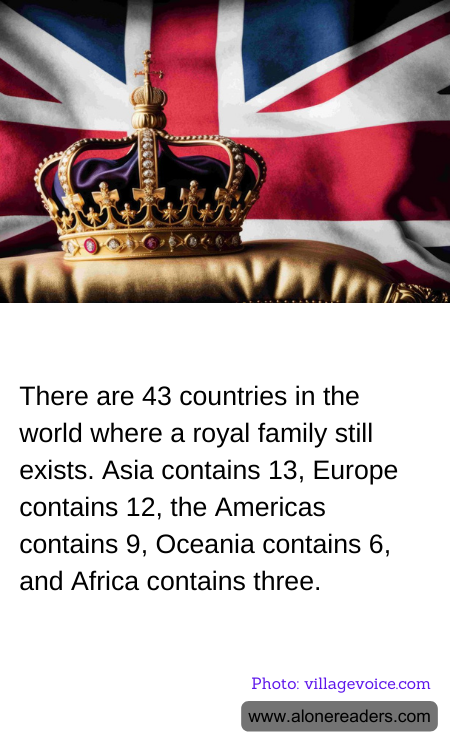
In an era where democracy and republicanism dominate global governance narratives, it's quite fascinating to find that royal families still rule in 43 countries across the different continents. These monarchies vary widely in their powers and prestige, from ceremonial figureheads to absolute rulers.
In Asia, the continent with the single largest share of remaining monarchies, 13 countries including Japan, Thailand, and Saudi Arabia, maintain royal families. These Asian monarchies often wield considerable influence, either as constitutional elements or as pivotal entities in their respective political systems. Japan's Chrysanthemum Throne, for example, is the oldest continuous hereditary monarchy in the world, rooted deeply in the cultural and spiritual fabric of the country.
Europe, with a rich history of kings and queens, is home to 12 monarchies. These include the globally renowned British monarchy, which attracts significant attention and tourism, alongside smaller, less conspicuous royal families like those in Monaco and Liechtenstein. European monarchies generally play largely ceremonial roles, though in some cases, such as in Monaco, the royal family is still central in the governance and administration of the country.
Over in the Americas, despite its strong association with republicanism, there are 9 countries under monarchical rule, primarily due to the territories under the sovereignty of European crowns, such as the UK's Canada and Denmark’s Greenland. These monarchies are characterized by a unique blend of local governance under the symbolic authority of a crown that may be situated thousands of miles away.
Oceania, with 6 monarchies, also sees a similar arrangement with countries like Australia and New Zealand recognizing the Queen of England as their official monarch, though her role is entirely ceremonial and symbolic. These countries are independent nations but share a personal union with the British Crown, reflecting a colonial legacy that has endured into the present.
Africa, with only three monarchies, has perhaps seen the most transformation in terms of governance, with kingdoms like Lesotho, Morocco, and Eswatini (formerly Swaziland) representing the traditional forms of monarchy integrated into the nation-state format. In Morocco, for example, the king still plays a crucial political and social role, blending modern governance with traditional authority.
Across the globe, these remaining royal families stand as symbols of continuity amidst change, embodying traditions that stretch back centuries and yet continually adapt to the modern world. Whether as ceremonial figureheads or active rulers, monarchies continue to fascinate and influence millions, offering a unique perspective on governance and power in the 21st century.
