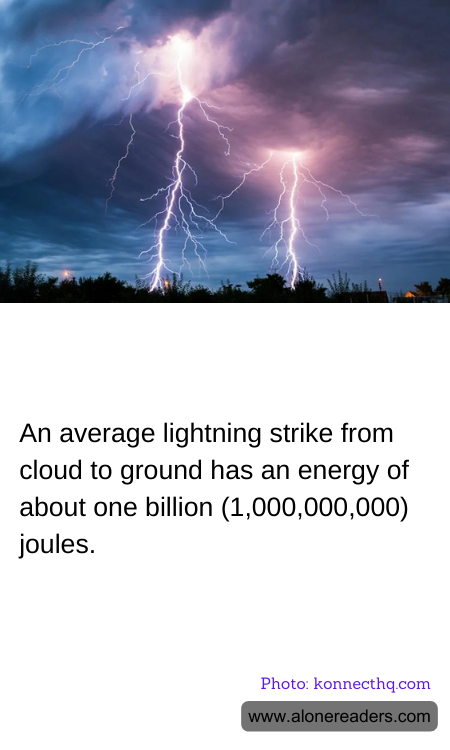
Lightning is one of nature's most powerful and spectacular phenomena. Each flash of lightning can light up the sky with an awe-inspiring display of energy. Interestingly, an average lightning strike from cloud to ground carries about one billion joules of energy. To put this into perspective, this amount of energy is equivalent to the energy released by approximately 240 kilograms of TNT exploding. This immense energy is transferred in a very short duration, lasting typically around 30 microseconds.
This colossal amount of energy in a lightning strike occurs due to the separation of positive and negative charges within a storm cloud. As the storm develops, interactions caused by rising and falling air currents within the cloud result in these charge separations. The negatively charged particles gather at the lower part of the cloud, while the positively charged particles accumulate at the top. When the negative charge at the bottom of the cloud becomes strong enough, it repels the negative charges on the ground below, inducing a positive charge on the ground. The attraction between these oppositely charged regions grows stronger until the air, which is normally an insulator, can no longer resist their pull. This results in a rapid discharge of electricity — known as a lightning strike.
The intense heat from a lightning strike, which can reach temperatures five times hotter than the surface of the sun, causes the surrounding air to rapidly expand and create a sonic shock wave, known in common terms as thunder. The energy from lightning can be destructive when it hits grounded objects like trees, buildings, or even open fields. It can cause fires, power outages, and damage to electronics and infrastructure.
Despite its potential for destruction, lightning plays a crucial role in Earth's nitrogen cycle. The high-energy processes in a lightning strike enable the nitrogen in the air to combine with oxygen, forming nitrates that are then deposited in the soil. These nitrates are vital nutrients for the growth of plants.
Understanding lightning and its implications has led to improvements in weather forecasting, safety protocols, and lightning protection systems for buildings and other structures. These systems often include lightning rods that safely direct the energy of a lightning strike into the ground, protecting the structures from damage. Awareness and safety measures can significantly mitigate the risks associated with lightning, especially in areas prone to frequent thunderstorms.
In short, lightning, with its formidable one billion joules of energy, not only showcases the power of nature but also plays a significant role in ecological and human systems. Its study continues to enlightl scientists and researchers, contributing to innovative solutions for safety and environmental benefits.
